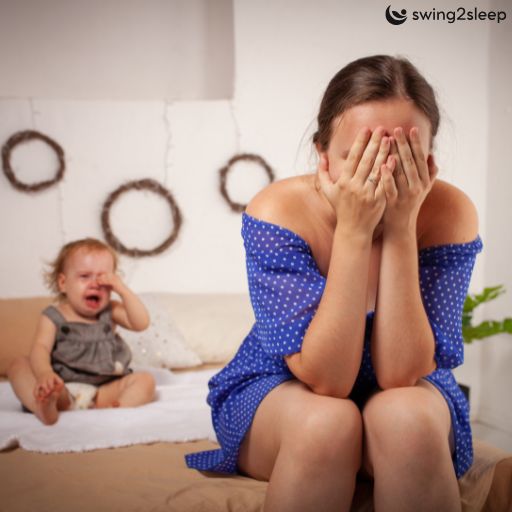


When your nerves start to show signs of wear and tear in the first few weeks after birth, the temptation may arise to let the baby cry and weep. Whether out of pure exhaustion or out of concern about spoiling the child.
In the process, it is quickly forgotten that newborns have no other way to express themselves. When they cry, they have something to tell you. If they are ignored in their existential neediness, it can have serious consequences for their later life.
Letting them weep and cry has an impact on the relationship, and the Ferber method can also massively influence the stress levels of babies who are not yet able to regulate their behavior themselves. You can find out what effects disregarding the needs of little ones has in the following article.
Letting the baby cry: A momentous mistake with an impact on basic trust
Babies never cry without a reason: Behind every crying infant is an unfulfilled need or pain. There can be various reasons why little ones cry, but in such a situation, parents should react immediately in the first months of life and trust their own intuition, which is to soothe the crying.
According to an Australian study from 2016, a baby's crying has no influence on cortisol levels, which are responsible for the perception of stress. Thus, it was claimed that children could be left to cry without endangering the physical and mental health of the infants. The outcry that went through the media was great, and in addition to criticism of the study, research in this area was pushed forward.
In the dissertation "Remember the Time you Cried", it can be read, among other things, that prolonged crying when falling asleep can lead to post-traumatic stress disorder.
Monkeys in comparison to humans
Monkeys are already significantly more independent than us humans directly after birth. A tiny human being cannot see properly at birth, let alone walk. It basically cannot move around at all. Furthermore, there is a constant danger of it getting too cold or dying of sudden infant death syndrome.
In order to have roughly the same level of development at birth as a baby monkey, human babys would have to stay in the womb for a full 16 months! Compared to some other animal species, it would even be 21 months.
But why does a pregnancy in humans last only 9 months? Humans are creatures with an upright gait, which is why their pelvis is somewhat narrower than that of other mammals. At the same time, the baby's head must fit through the birth canal during delivery. Ending the pregnancy after nine months seems like a compromise: Birth occurs when the child can already survive outside the womb, but the head is still just small enough.
The human – a physiological premature birth
Since humans are born completely helpless and naked, they would be left to their own devices and certainly doomed to death. In the animal kingdom, this generally also applies to so-called altricial species. But what does this mean for you as a mother or father?
Quite simply: Your little one is dependent on you from the start. Okay, you certainly already knew that. But they are truly 100% dependent on you. They have no other option than to express their displeasure by crying.
By nature, they are "unfinished" and not in a position to get by alone. So they must ask you for help through their voice, through short sounds and through their crying and hope for the affection of their parents. Care for your baby exactly to the extent that they need you.
They certainly do not want to annoy you when they cry. Something is then not as it should be. Your baby signals to you, their most important trusted persons, through crying that something is wrong.

What happens to children that we let cry?
By now, it should really be common knowledge that letting a baby cry it out and leaving them to their own devices is not a good idea. Admittedly, it can sometimes be tempting – especially when the feeling creeps in that your child cannot find their way to sleep alone.
Shouldn't it be the case that babies eventually find their way to sleep alone in their own little bed, without mom or dad having to rock or carry them to sleep?
That is why many parents even today still think they are helping their child's development a little if they let them cry for a few minutes before falling asleep. They believe that through such sleep training, the baby learns to fall asleep alone more quickly.
However, this is often a misconception, because the crying could also have an important cause. Your baby might be going through a sleep regression. These are phases in which babies suddenly sleep restlessly and wake up often. This is frequently related to developmental leaps. Simply letting the baby cry then will have no effect.
Instead, you should try to calm your baby. The Automatic baby hammock from swing2sleep can help you with this, which for many of our customers is like a miracle cradle. You place your baby in a hammock where they feel particularly comfortable, closely embraced as if in the womb, and calm down faster.
Why you should not let your baby cry: Physical and psychological effects
It is actually suspected that letting a baby cry has not only psychological but also physical effects on the baby.
- Stress: There is always a reason why babies and highly sensitive children cry. If the mother or father does not immediately recognize why their child is crying or, worse still, if they do not want to react immediately to the crying so as not to spoil their child, stress hormones are released that massively influence the child's development.
- Emergency program: Without comfort, closeness, and physical contact, the child begins to switch to an emergency program in the brain. Reflexively, a kind of shock paralysis sets in, which is intended to protect your little one from predators – they play dead.
- Fear of death: An infant where the decision is made to let them cry will not have fewer needs and therefore cry less. Experts say that babies feel almost a fear of death, because they feel abandoned and do not know that they are currently receiving a lesson in falling asleep alone. The parent-child relationship can be massively disrupted, especially in the first months of a child's life.
Children need closeness – reliably and at any time
Physical closeness is one of the important basic needs of babies, and they must be able to rely fully on this need being met immediately when they demand it.
This is not only important to reduce the stress that arises during crying, but also serves to build a trusting parent-child relationship. When parents cuddle and snuggle a lot with their child, it pays off: such children are later more self-confident, healthier, less depressed, and show fewer behavioral problems.
Letting a baby cry? The risk of trauma is high
A baby who is frequently left to cry by their parents can develop actual trauma that can then accompany them into adulthood. Possible long-term consequences include attachment issues – which is no surprise, as your child has learned through this that it is generally better not to trust other people.
Yet basic trust and trust in other people in general is so important! Furthermore, it can lead to other problems such as sleep disorders, depression, or even addictions.
Is it educationally sound to let a baby cry?
It can therefore be said with great certainty that letting a baby cry simply has no educational value; quite the opposite. Parents who let their child cry are doing neither themselves nor their offspring any favors.
Most of the time, the plan doesn't work out anyway: Simply letting the child cry in the hope that they will eventually calm down on their own is not only cruel but also usually doesn't work. If their crying is not heard, most babies only spiral further into their despair.
The best advice in such a situation seems surprisingly simple: ignore all the guidebooks, well-meaning tips, and over-intellectualized theories, and listen to your gut when your child cries. Listen to your instinct.
It will tell you to respond immediately to the crying of your baby. Both the crying and the reaction to it are completely natural reflexes, which also seem to be perfectly coordinated with one another.
But what if you follow your instinct, take care of the child's basic needs immediately, and yet your baby simply won't stop crying?
No matter how much you carry them around, sing, play, or rock them – nothing seems to help. When all options seem exhausted, you have no choice but to let them cry, right?

Letting a child cry works – eventually
It is truly no great feat: if you let the child cry long enough and ignore all their increasingly desperate cries for help, it will eventually become quiet in the nursery. The strategy was successful, but the consequences are devastating.
When babies give up after a while, it is not out of the realization that Mom and Dad are annoyed by their crying, but out of desperate resignation. They experience that no one comes, no matter how much they cry. They have been abandoned despite all their vulnerability, and that is a deeply existential experience. Their becoming quiet is essentially equivalent to a protective paralysis.
In their book "Schlaf gut, Baby", pediatrician Herbert Renz-Polster and author Nora Imlau have vividly described this situation:
"[The children] do what all mammals do when they are stuck in a hopeless situation: they become silent. They fall into what biologists call protective paralysis: anyone who can escape neither by fighting nor by fleeing is well advised to save energy. And those who have learned that no help is coming anyway should not draw the attention of predators to themselves. The fact that the child is quiet does not mean that they have learned to sleep. They have learned not to protest."
Freezing response or dissociative state
This situation is traumatic for the child. It cannot survive without help, but even though it screams, that help does not come. The result is feelings of panic, loneliness, and powerlessness.
This experience is so emotionally overwhelming that the consciousness reacts like an overloaded machine. It shuts down the overloaded area. This leads to a dissociative state.
The baby does not only split off the feelings of panic or powerlessness, but also those that triggered the situation: hunger, thirst, or the longing for physical closeness.
These feelings have not disappeared as a result, but are suppressed to such an extent that the child manages to remain still. Such babies are not sleeping, but are lying awake in their cribs and do not speak up.
These children have indeed learned something fundamental from your lesson: that no one comes when they are in distress. That they cannot rely on anything. That they are not worth being cared for.
The supposedly harmless attempt to train your child to sleep by letting them cry it out has the potential to create trauma that can, under certain circumstances, poison your child's entire later life.
How do I behave with a high-need baby?
You now know that you should never let a baby cry alone. But what about high-need babies who simply cannot be calmed down? High-need babies lack the ability to calm themselves. They are often overwhelmed and have a regulation disorder. If babies cry an enormous amount and cannot be calmed, such a disorder could be the reason.
Nevertheless, crying is always an expression of displeasure and you should definitely respond to your baby. Why babies cry can have many causes – but at first, it doesn't matter why the baby is crying. When it cries, it needs you and you should take care of it. No matter why it is crying. This naturally also applies to high-need babies.
What else does crying it out lead to?
In her book "The Science of Parenting", the British child psychologist Margot Sunderland explains exactly what happens in a baby's brain in the first months of life when it is left to cry it out. Using brain scans, she shows how early childhood stress can program a person's stress response system for permanent hypersensitivity.
This means that your offspring may possibly be more susceptible to anxiety, depression, anxiety disorders, alcoholism or other illnesses later in life. Also insomnia, heart disease, asthma, high blood pressure or panic attacks can be triggered by early childhood stress.
The cause is that the hippocampus in the brain of affected babies slightly shrinks. Adults in whom this brain region is smaller perform worse in various tests. There are even theories that consider early childhood stress as a possible trigger for premature brain aging.
Secure attachment strengthens trust
Conversely, this shows how important it is for the child to feel noticed and taken seriously, loved and protected. If they experience the reinforcement and bonding they so desperately need during their most vulnerable phase of life, they can grow into a healthy and self-confident person who looks at themselves and the world with confidence.
The bond between parents and child is a central building block for establishing trust and healthy relationships. Children who feel safe and secure in the relationship with their parents are better able to master difficult situations later in life. They are more resilient to stress, show more empathy and are more self-confident. All of these are decisive factors for one's own ability to form attachments and for success in life.

Empathy can be learned
Empathy is not only innate, but also learnable. Babies who experience firsthand that their parents care for them when they cry can later build more empathy and better relationships in their interactions with other people. When your baby cries in the evening or at night, you should let them feel that they are not alone and that their needs are taken seriously and considered important.
Even if it can be exhausting in the moment, you are doing yourself and your child an incredibly big favor in the long run and strengthening your parent-child relationship. Not letting babies cry is incredibly important.
With our automatic baby hammock from swing2sleep, you can create a place of protection, security, and relaxation for your baby. It is designed so that your child feels as safe in it as in the womb. This makes it much easier for them to calm down and find their way to sleep.
The gentle up-and-down movements help when the baby is restless, going through a sleep regression, or crying. You offer them a cozy nest in which they can fall asleep feeling secure. You can easily control the automatic baby hammock motor via the app and even receive push notifications when your baby wakes up.
Our Wunderwiege has already inspired more than 180,000 parents and is recommended by osteopaths and midwives. See for yourself!
Frequently asked questions about letting babies cry
Should you ever let a baby cry?
A baby does not cry without a reason. Crying is the only way to communicate needs such as closeness, hunger, safety, or being overwhelmed. Especially in the first months of life, it is important to respond to crying. Deliberately letting a baby cry does not serve independence, but can trigger stress and impair the baby's sense of security.
What is the maximum amount of time a baby should cry?
There is no fixed period of time that is considered "harmless." Babies should not be left to cry alone for long periods. When a baby cries, they need companionship, closeness, and comfort. If the crying persists for a long time and the baby cannot be calmed, it may be useful to clarify possible causes and seek support.
Is crying good for a baby's lungs?
No. The assumption that crying is good for the lungs is a widespread myth. Babies do not need to cry to train their lungs. On the contrary: persistent crying is associated with stress reactions in the body. For healthy development, closeness, security, and comfort are much more important than "enduring" crying phases.
What to do if the baby cries and cannot be calmed?
If a baby cannot be calmed, it helps to stay calm and try different forms of closeness. Carrying, gentle movements, steady rocking, or physical contact can help relax the nervous system. Some babies respond particularly well to rhythmic movements and a limited, protected environment. It is also important that parents relieve themselves and accept support.