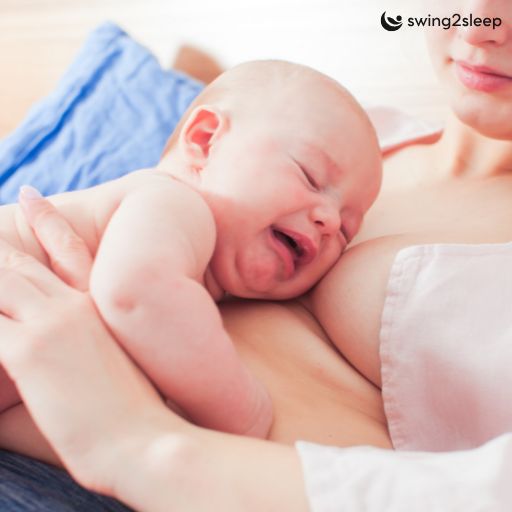



In connection with high-need babies, the term "three-month colic" is often mentioned. Affected parents also find themselves confronted with regulatory disorders or simple flatulence.
Whenever your baby has a stomach ache, you as a mother or father suffer too. In this article, we summarize helpful information and tips for you.
Stomach ache in babies: Three-month colic or regulatory disorders?
It is certainly true that almost all babies suffer from flatulence or stomach aches at some point. For a long time, it was even said that high-need babies have stomach aches every day and that is why they cry so much. The so-called three-month colic was virtually the standard finding for restless babies.
This diagnosis gave parents the feeling that the nightmare might be over after three months. On the other hand, the term "colic" also triggers fear in parents that their little sunshine is suffering terrible agony. This idea is now considered outdated.
Although the term "three-month colic" has persisted in popular parlance, the focus is now on regulatory disorders in children. This means that the infant has difficulty processing all the many impressions that have bombarded them during the day.
They then express this overwhelm by crying. One indication of this is that the crying fits take place mainly in the evening hours and disappear again on their own after about three months.
But how can parents be sure that their child is not suffering from stomach ache or perhaps something worse? Of course, in case of doubt, it is always advisable to see a doctor to clarify exactly what is wrong with the child. However, there are some signs that give parents an initial indication of stomach ache and flatulence:
- Due date: The "colic" of premature babies only starts about two weeks after the originally calculated due date. Premature babies have a lot of intestinal gas and a pronounced gastrocolic reflex. If this were the cause of the crying fits, the signs would appear immediately after birth.
- Time period: The crying fits usually begin at the age of two weeks, reach their peak at six weeks and end at three to four months. This cannot be explained by flatulence or the gastrocolic reflex, as both are present from birth and last much longer than three months.
- Crying in the evening hours: The three-month colic regularly reaches its peak in the evening hours and when the infant is tired. Bowel activity, especially bowel movements, does not yet have a fixed rhythm. The intestines of infants are active around the clock in the first months of life. If the symptoms were related to this, the child would cry with the same intensity in the morning and at noon as in the evening. However, the fact that the crying starts in the evening or when the child is tired indicates that it is processing the day's experiences.
Regulatory disorder or flatulence – what is the difference?
With three-month colic or a regulatory disorder, the baby generally finds it difficult to fall asleep, always wants to be carried and prefers to fall asleep in someone's arms. When the crying fits start, the newborn can hardly be calmed down.
The rule of thumb is: If the child cries for at least 3 hours a day on at least 3 days a week over a period of at least 3 weeks, it is by definition a high-need baby.
With ordinary flatulence, affected babies cry sporadically throughout the day, especially after feeding. They pull their legs up to their body and then stretch them out again jerkily, or they arch their back.
A baby with gas is often restless and hectic when breastfeeding or feeding. In addition, they often have a bright red head. They strain and pass gas while their face is contorted with pain.
If your baby suffers from flatulence and colic, an automatic baby hammock from swing2sleep can work wonders. In the hammock, the baby is protected from sensory overload, and the whisper-quiet motor provides gentle up-and-down movements just like in mommy's tummy.
What are the causes of three-month colic in infants?
It was previously believed that the immature digestive system of infants would lead to cramp-like pain, i.e., colic. Today, it is more likely assumed that a regulation disorder in combination with sensory overload of the baby is the cause.
Allergies and intolerances of the child as well as the dietary habits of the mother are only responsible for the occurrence or worsening of three-month colic in exceptional cases. However, there is agreement that a smoking mother is a contributing factor.
Contrary to previous assumptions, statistics show that both breastfed children and bottle-fed children are affected roughly equally. The frequency is also distributed approximately equally between the sexes. However, only about five percent of crying babies suffer from real colic, in the sense of agonizing abdominal cramps.
How you can prevent abdominal pain and flatulence
Flatulence is no longer suspected of being to blame for a high-need baby. Nevertheless, it is unpleasant and even painful for babies. To avoid flatulence, you can try to let your baby swallow as little air as possible when feeding; if your baby frequently has gas, you should pay special attention to this.
For a bottle-fed child, you should pay attention to the right bottle and nipple. In addition, the correct drinking position is crucial: you should hold the bottle as upright as possible. For breastfed children, the baby should have enough peace and quiet while drinking. If too much milk comes, they may choke during breastfeeding. Here it can help to express the breast slightly beforehand.
In both cases, you should not wait too long to feed: hungry babies are greedy and are particularly at risk of choking while drinking. This can lead not only to burping but also to abdominal pain in the baby.
It is controversial whether the mother's diet during breastfeeding affects the baby's digestion and potentially leads to flatulence. If your child suffers a lot from flatulence, it doesn't hurt to write down what the mother eats and how the baby reacts to it for a while. Perhaps a connection will emerge that you hadn't noticed before.
You may also be able to provide relief for your child with anti-foaming drops (ask your pediatrician!) and carminative tea with anise, fennel, or caraway. Breastfeeding mothers can also simply drink this tea themselves.

Avoid tummy aches: Let your baby burp
In between, but at the latest at the end of the meal, the child should be given time to burp. For this to succeed, the baby does not necessarily have to be placed over the shoulder, as was recommended in the past. In doing so, the adult's shoulder often presses unpleasantly into the baby's little tummy.
It is better to hold the baby upright on your lap in front of you. Support the child's arms slightly and lift them a little. You can also tap them very lightly on the back or guide the child's upper body in gentle circular movements. For some children, gently stroking the fontanelle also helps.
Crying leads to flatulence ... and to even more crying!
Your baby does not only swallow air while drinking. Air also gets into the belly during crying itself, which makes the symptoms even worse. The resulting flatulence leads to pain and even more crying.
While people used to think that flatulence was the cause of colic, it is actually the other way around: Three-month colic leads to flatulence. Unfortunately, this cannot be prevented unless you find a way out of the three-month colic.
An automatic baby hammock from swing2sleep can help you with this. It gently lulls your baby to sleep with its rhythmic movements. This has an antispasmodic and calming effect.
If your baby suffers from abdominal pain over a longer period of time, our automatic baby hammock could help. At the same time, it strengthens the parent-child relationship, gives you more time for yourself, and provides your baby with a natural sense of security.
Abdominal pain in babies: Helpful tips & home remedies for relief
Of course, despite all countermeasures, your baby may still get flatulence. But even then, there are a whole range of ways to help the suffering little one and get rid of the excess air in the belly. We summarize some tips and home remedies for colic and flatulence in babies:
-
Football hold: Carry your baby on their stomach in the so-called "football hold". The even pressure on the belly ensures that the gases can escape better from the baby's tummy.
-
Tummy massage: A tummy massage with wind salve or caraway oil can work wonders. To do this, perform gentle circular movements clockwise around your baby's belly button. Massaging can have a positive effect on the digestive tract.
-
Heat: Heat also frequently helps – for example, with a cherry stone pillow on the baby's belly (not too hot).
-
Carry, carry, carry: Children who are carried actually suffer significantly less from flatulence. The squat-spread position that the baby assumes, combined with the warmth of mom's body, ensures that air escapes quickly.
-
Drops: Administering drops or suppositories from the pharmacy could also help: However, you should definitely ask your midwife or a doctor beforehand.
Baby abdominal pain: Parents suffer too
The first few months after birth in particular are a tough test for most parents, but it hits parents of a high-need baby the hardest. Their child suffers from recurring, violent crying fits. Good advice is often hard to come by, as the cause is rarely clear.
Over time, the symptoms often improve all by themselves: Digestion gets going, the day-night rhythm develops, and the baby perceives its environment in a more differentiated way.
After just three months, the tiny tot becomes a little person. This rapid development is, of course, also enormously demanding for the child. Particularly sensitive children may be overwhelmed by it.
They are simply overstimulated and annoyed, find it harder to settle down, and consequently suffer from a lack of sleep. Without being able to express themselves in any other way, crying is their only outlet in this unfortunate situation.
Particularly important: Stay calm
High-need babies push us to our limit. Therefore, staying calm is often easier said than done. Nevertheless, it is the be-all and end-all. The little ones have very fine antennae and sense the helplessness of their parents.
For an infant who instinctively knows how dependent they are on you, this is anything but soothing. To help you cope better with the situation, we have put together 28 tips for you.
One of the most important tips is – spoiler alert – an automatic baby hammock from swing2sleep. With its gentle up-and-down movements and cozy snugness, it creates conditions that the child still remembers from the womb.
This provides security and a sense of safety, so that the child can finally relax. The effect is phenomenal, but we'll let those affected tell you themselves.
Automatic baby hammock from swing2sleep: What do affected parents say?
We are asked time and again:
-
Does this automatic baby hammock really work?
-
Does it also provide relief for three-month colic?
-
Does it help my high-need baby?
As the inventors and providers of the swing2sleep automatic baby hammock, we are of course not entirely unbiased. Therefore, it is understandable if you are skeptical about whether our offer really helps against three-month colic. So, for the rest of the article, let's hear from those who should know best: our customers.
Kristina seems quite satisfied:


Our automatic baby hammock motor is also compatible with other products. Therefore, Karin did not have to purchase a complete system, but only needed a motor to make her baby – and herself – happy.

Tobias is convinced by the swing2sleep because his little one is too:

Andreas Mann's skepticism should also have subsided by now:
Ramona is happy to have time to shower again. We hope that someone kept an eye on the little sunshine during that time.

Sandra got the tip from her midwife (back then swing2sleep had a different name):

The swing2sleep also proved to be a family lucky charm for Katinka, Heiner, Bente, and Mattis:

The sibling will have been happy about the swing2sleep. This way, Mom Steffi finally had time to play again:

And this family was also made happy by the swing2sleep:

If you already have a swing2sleep at home, feel free to write your experiences in the comments. We look forward to your feedback.
If you don't have a swing2sleep yet, you can change that here. We hope we were able to convince you too.