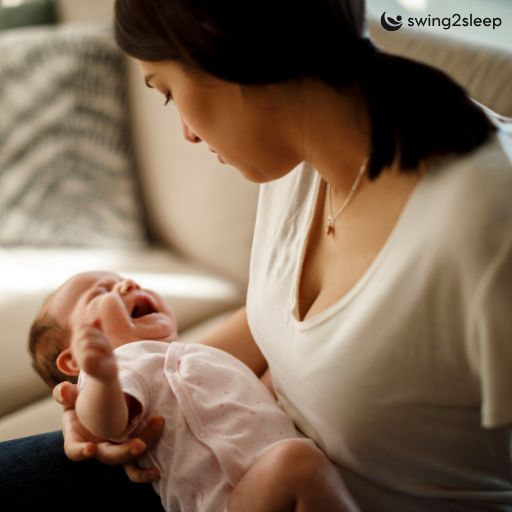


After pregnancy and the arrival of your little treasure, your world is probably turned upside down at first. Often, topics like contraception after birth get lost in the shuffle.
However: If you don't want to get pregnant again right away and want to focus on your little one first, the question of contraception is not insignificant. So what should you look out for? And what breastfeeding-compatible options are there? We have the answers.

Contraception after birth: Breastfeeding does not protect against pregnancy
Couples often believe that they cannot get pregnant at all after a birth. Especially if the child is fully breastfed. In fact, this is only partially true. Nature has arranged it so that when breastfeeding, the milk-producing hormone prolactin is released. This restricts ovarian activity. Ovulation is prevented. However, this natural contraceptive protection after birth is not 100 percent reliable. The Pearl Index is 2-4. This means that at least two to four women out of a hundred can become pregnant within a year despite breastfeeding after birth. Other studies even speak of five to ten percent.
Full breastfeeding in this case means:
- During the day you breastfeed at least every four hours, at night at least every six hours.
- In general, the breastfeeding breaks are never longer than 6 hours.
- Pumping and bottle feeding do not count as breastfeeding.
- You breastfeed for at least 80 minutes daily.
- You do not supplement feed.
- You have not had a period yet. A period is considered to be if you have bleeding for at least two days more than eight weeks after birth (not lochia).
In short: Assuming that breastfeeding alone protects against renewed conception is not safe. So if you don't want another pregnancy for the time being, you should pay attention to these things regarding contraception after birth.
Get advice first
If you are not breastfeeding for any reason, you can choose your contraceptive relatively freely. During the breastfeeding period, on the other hand, you need a reliable method of contraception that does not affect your baby's health or your milk production. Therefore, it makes sense to consult your gynecologist and get some advice. Afterwards, you can better assess the advantages and disadvantages of the individual contraception methods together. For example, it may be that you use a different method of contraception during the breastfeeding period than afterwards.

Contraception after birth with the barrier method
The "barrier method" refers to condoms or diaphragms. They are particularly suitable as a method of contraception after birth, as they have no effect on milk production or the baby. You can therefore use them without hesitation. However, make sure that the diaphragm is refitted and that it sits correctly. Because your body has changed through childbirth, especially your pelvic floor. Only the correct use of a condom or diaphragm ensures secure protection.
Pill or mini-pill
Not all pill preparations can be taken without hesitation during the breastfeeding period. For example, the combination pill is not a good idea. It contains estrogens, which can affect milk production. If you are not breastfeeding, you can certainly take the combination pill – at the earliest three weeks after the birth or later. Otherwise, the risk of thrombosis is too high in the early stages of the postpartum period.
The mini-pill, on the other hand, is lower dosed than the combination pill and contains only the hormone progestogen. It is therefore an option for breastfeeding moms, as it does not affect milk production. That's why it's also sometimes called the breastfeeding pill. If you are fully breastfeeding, you can take the mini-pill at the earliest six weeks after delivery. If you are not breastfeeding, you can start using it at any time.
Copper coil
The copper coil is wonderfully suitable as a method of contraception after birth. It can often be inserted by the gynecologist as early as six to eight weeks after delivery – because by then the uterus has largely regressed. However: Inserting the coil is not entirely painless. Your body usually still needs time to recover after birth. So think carefully about when you feel ready for the insertion of a copper coil.
Hormonal coil
Similar to the mini-pill, the hormonal coil is also low-dosed. This means: It is also suitable as a method of contraception during the breastfeeding period.
Hormone implant
Another option for breastfeeding moms are hormone rods that are placed under the skin in the upper arm. They usually only contain the hormone progestogen and offer protection for up to three years. However, it should be mentioned at this point that the data situation regarding hormone implants and the quantity and quality of milk is relatively low. There is not yet much experience with this method of contraception after birth.
Three-month injection
The three-month injection also contains only progestogen. It is theoretically an option for breastfeeding moms. It can be given at the earliest six to eight weeks after delivery. However, many women do not tolerate the injection due to its side effects. So get detailed advice here again.
Vaginal ring
The vaginal ring, on the other hand, is not a recommended method of contraception after birth and during the breastfeeding period. Because, as with estrogen-containing pills, hormones are released here that can restrict milk production. The same applies to the contraceptive patch, which is a combination preparation of estrogen and progestogen. For non-breastfeeding moms, however, the vaginal ring can be a method of contraception after birth.
Only in an emergency: The morning-after pill
If a small mishap has occurred, you can use the morning-after pill in an emergency. However, you should note the following:
- If the product contains the active ingredient levonorgestrel, the preparation should be taken directly after breastfeeding. In addition, a breastfeeding break of at least 12 hours is required.
- If the preparation contains ulipristal acetate, a breastfeeding break of at least 36 hours is recommended.
If the breastfeeding breaks are not observed, your baby will ingest the active ingredient via the breast milk. Note: Despite the breastfeeding break, you should continue to pump breast milk so that milk production is not restricted or reduced. As mentioned, the morning-after pill is really only an emergency measure.
Contraception after birth: When the desire returns
By the way, it varies greatly from couple to couple and especially from woman to woman when the desire for sex returns after birth. For some it happens relatively quickly, for others it can take a few weeks or even months. If the latter is the case for you, don't let it unsettle you. It is quite natural that the libido is still a bit sluggish, especially in breastfeeding women. Simply find other ways to be intimate with each other in everyday baby life. Cuddle as a couple or together with your little treasure as a family: this releases happiness hormones and is quite wonderful. It is important that you don't stress yourself too much about the topic. You set the pace.
And: If the desire does overcome you, the swing2sleep is a great helper to let your little one slumber blissfully while you make yourselves comfortable in bed and enjoy a little adult time.