


Podcast tip:
The most important facts in brief
- Main problem: 8 avoidable mistakes sabotage baby sleep
- Most common mistake: Inconsistent bedtimes disrupt the rhythm
- Most critical timing: The "sleep window" - 20-30 minutes optimal time to fall asleep
- Solution: Fixed routines, recognizing signs of tiredness, low-stimulation environment
- Timeframe: Improvement in 1-2 weeks with consistent implementation
Probably all parents have to struggle with this problem to some extent: the baby simply doesn't sleep the way you would like it to. Either it has trouble falling asleep, it won't fall asleep alone, it doesn't sleep through the night, or it turns night into day. As parents, this can quickly leave you running on empty, because your baby's sleep problems also rob you of your much-needed night's rest, and sleep deprivation can really take its toll.
As parents, this can quickly leave you running on empty, because your baby's sleep problems also rob you of your much-needed night's rest. Finding the right sleep aid for babies becomes a challenge - and sleep deprivation can really take its toll.

Sleep aid for babies: Hurdles on the way to a good night's rest
Especially for new parents, getting the baby to fall asleep can become a feat of strength. In the process, mistakes quickly creep in that make life unnecessarily difficult for you. But don't worry, help is here!
We have put together a few typical mistakes that happen time and again. If you avoid them in the future, you might soon be granted a little more sleep again.
Mistake 1: Parents are inconsistent
In short: If bedtimes vary daily, the baby's body cannot develop a stable day-night rhythm. The result: difficulty falling asleep, frequent waking, and overtired parents.
Quick answer:
Babies need the same bedtime every day (±30 minutes). Without a fixed routine, a healthy sleep-wake rhythm cannot develop.
It is completely understandable and actually quite sweet that working parents want to see something of their offspring and spend a bit of their limited time with them when they come home late from work in the evening. So, the bedtime is simply pushed back a little.
However, this breaks the routine that should absolutely be followed before going to bed. Fixed bedtime rituals and bedtimes are extremely important for babies and toddlers.
Even if it is difficult to always be consistent, you are doing neither yourself nor your child a favor by being lax with the procedures. If the bedtime varies constantly, the child cannot find a rhythm. The organism gets out of sync and never knows when it is time to wind down.
Therefore: Consistently stick to fixed bedtime rituals and also to fixed bedtimes. These are the most important sleep aids that cost nothing.
Mistake 2: First signs of tiredness are ignored
In short: Babies only show optimal tiredness for 20-30 minutes - after that, it tips over into over-tiredness with stress hormones. Missed sleep windows mean hours of bedtime battles.
Recognizing signs of tiredness:
- Yawning
- Rubbing eyes
- Looking away
- Fussing
Act immediately! After 30 minutes, it's too late.
When baby yawns, rubs their eyes, makes faces or frowns noticeably often, and on top of all that clearly turns away from what's happening, then this usually means that they are tired and want their peace and quiet. Parents should by no means ignore these signs, because if the baby doesn't get to rest now, their body releases stress hormones, and then falling asleep becomes increasingly difficult. In this context, one also speaks of sleep windows. As long as the sleep window is open, the baby can fall asleep relatively easily. If this window is missed, you will usually have to deal with a cranky child. However, they certainly won't fall asleep now!
💡 What is a sleep window?
Definition: The sleep window is the optimal period of 20-30 minutes during which a baby is tired enough to fall asleep, but not yet overtired.
Signs: Yawning, rubbing eyes, becoming quieter, looking away
Important: If the sleep window is missed, the body releases stress hormones (cortisol) - the baby becomes awake and restless again.
Therefore: Observe your baby very closely and react to the signals it gives you.
Mistake 3: Too many stimuli
In short: An overstimulated baby cannot switch off despite being tired - the brain is running at full speed. At least 60 minutes of quiet time before sleep are essential.
Even if most parents only mean well for their offspring: Permanent exposure to stimuli is too much of a good thing. While the baby finds everything new incredibly exciting, it cannot process so much information. As a result, it finds it difficult to fall asleep.
Therefore: Ensure that your baby does not experience anything exciting for at least one hour before bedtime. Wild games that could pump the baby up are also taboo now.
💡 Practical sleep aids:
What parents do against sensory overload:
- Darkening the room (helps 60% of babies)
- White Noise (helps 40% of babies)
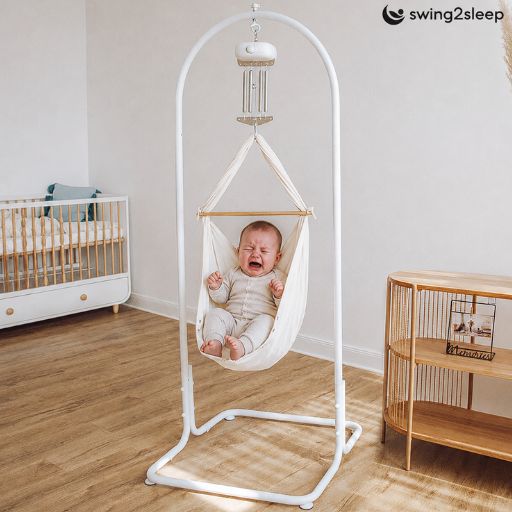
- Limited sleep environment such as a side bed or automatic baby hammock (helps 70%)
"For our son, the combination helped: automatic baby hammock with the high side walls plus white noise. The movement calms him down, the walls shield him - like a little cave."
- Thomas, father of Leon
Mistake 4: Constant switching between family bed and baby crib
In short: Constant switching between co-sleeping and their own bed confuses the baby and destroys sleep associations. Consistency with the chosen sleep environment is the key to peaceful nights.
Whether you let your baby sleep with you in the family bed or alone in the baby crib is entirely your business. Opinions differ here like on almost no other topic. Co-sleeping has advantages, but also disadvantages.
💡 What does co-sleeping mean?
Definition: Co-sleeping refers to parents and baby sleeping together in the same bed or room.
- Bed-sharing: Baby in the parents' bed
- Room-sharing: Baby in its own bed in the parents' bedroom
Recommendation: The AAP recommends room-sharing without bed-sharing for the first 6-12 months.
However, once you have decided on a variant, you should stick with it. With a constant switch between sleeping in their own crib and co-sleeping, the sleep rhythm of everyone involved is significantly disrupted. A restful night's sleep is then no longer possible.
Therefore: Agree as a couple on which variant you choose, and then consistently stick to this agreement.
Mistake 5: Letting the baby sleep everywhere
In short: Stroller, car seat, sofa - changing sleeping locations prevents the important association "bed = sleep". Additionally, the quality of sleep outside the bed is significantly poorer.
After a particularly exciting day, it is only logical that your offspring can simply fall asleep anywhere on the spot. While this makes a cute impression and is also incredibly practical, it carries many disadvantages.
For instance, a nap in a car seat is nowhere near as relaxing as deep sleep in a cozy little bed. In addition, the sleeping position in such car seats is anything but healthy.
Furthermore, in the long term, your child should learn to link the concept of "bed" in their consciousness with "sleep" and vice versa. Likewise, the baby should be optimally dressed for sleeping.
Therefore: Whenever possible, always put your baby to sleep in their bed at fixed times. They are guaranteed to sleep better there than in a car seat.
Mistake 6: Keeping the baby awake
In short: "Tiring them out for sleeping through the night" does not work - overtired babies sleep worse and wake up more frequently. Also, naps that are too long (over 2 hours) disturb night sleep.
For some parents, the prospect of finally sleeping through an entire night again may be so tempting that they settle on a daring plan. They keep the baby awake during the day until they are really tired in the evening and then sleep through until the next morning.
If you think this is a good idea, we unfortunately have to disappoint you. In fact, this plan almost never works. No matter how tired the baby may be, they will likely still wake up in the middle of the night or very early the next morning. And then, due to the sleep deficit you caused, they will be in a REALLY bad mood. Sleep cannot simply be shifted back and forth at will.
Through sleep deprivation, your baby will not automatically sleep longer afterwards.
If, on the other hand, your baby naps for hours at midday, they will be bursting with energy in the evening and won't want to see why they should sleep. A three-hour midday nap might give you a breather, but it is still a bit too long. The nap should be over after two hours.
If your offspring is already dog-tired and on the verge of falling asleep at six in the evening, it can make sense to keep the baby awake for another hour or two until it is time for night sleep. If you let them fall asleep at six, it is foreseeable that the night will be over for you at four in the morning.
Therefore: Do not forge a diabolical plan to deprive your child of sleep so that they sleep through the night. That only backfires. However, you can regulate sleep a little by not letting the midday nap get out of hand and keeping the child awake in the evening until their regular bedtime.
Mistake 7: Switching to their own toddler bed too early
In short: Before the age of 3, toddlers lack the impulse control to stay in bed at night. The crib is safety, not a prison - it protects against nighttime exploration tours.
Many parents cannot wait and let their child sleep in a big bed too quickly. However, it is recommended to wait with the move out of the crib until the child is about three years old. Up to this age, the bars have a logical purpose: they prevent the child from going on an unsupervised exploration tour at night when they wake up.
Therefore: Have patience. The crib protects your children until they are old enough.
swing2sleep: The safe alternative to a big bed
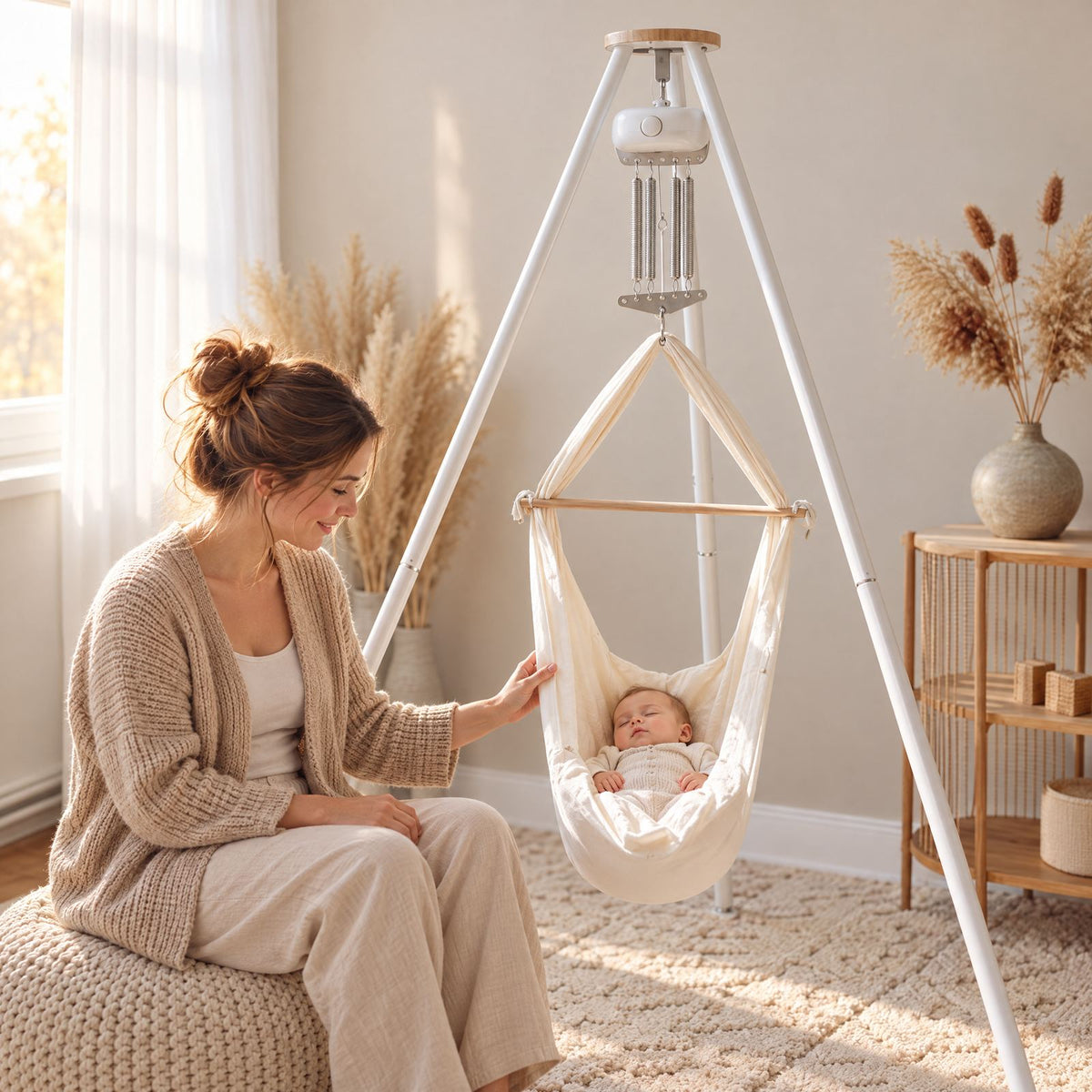
Before the transition to a big toddler bed is due, the swing2sleep automatic baby hammock offers an ideal intermediate solution. The enclosed side walls give your child security and a sense of safety - similar to a crib. At the same time, the gentle rocking movements promote deep, restful sleep. This way, you avoid many of the mentioned mistakes: the baby has a fixed sleeping place, is protected from sensory overload, and can optimally use their natural sleep window.
Mistake 8: Disagreement between parents
In short: If Mom enforces a 7 PM bedtime and Dad enforces 9 PM, the baby loses all sense of orientation. Parents must act as a team - different rituals are okay, but the basic rules must be identical.
Raising your child is teamwork, and it only works if you are in agreement. Especially when it comes to sleep, it quickly becomes very confusing for the child if Mom and Dad are not pulling in the same direction. This prevents them from finding a fixed rhythm.
Agree on when the child should go to bed and implement this consistently.
By the way, this by no means means that your bedtime rituals have to be exactly the same. On the contrary: children quickly learn that Mom and Dad have different habits here. However, it is important that you stick to fixed bedtimes and avoid wild games before going to sleep.
Therefore: support and complement each other, but above all, never work against each other. Only in this way do you give your child security and structure.
The fascinating benefits of rocking while sleeping
This is what you will learn in the article and video with swing2sleep founder Maik Schwede:
- ▸ What influence rocking has on babies
- ▸ Which scientific studies exist on improving sleep quality
- ▸ Why horizontal rocking is more effective
Tip: Don't give up!
Yes, the nights can be hard. Yes, you will sometimes be desperate. And yes, there will be moments when you think: "It will never get better!"
But here is the good news: Every small improvement counts. Start with one of the 8 mistakes - the one that is easiest for you. Maybe you start by introducing fixed bedtimes. After a week, add the next point.
Document the progress in a sleep log. You will be surprised how much can change in 2-3 weeks. And remember: you are not alone. Every pair of parents struggles with sleep problems - some more, some less.
Practical immediate help for tonight:
- Watch for the first signs of tiredness
- Dim the lights an hour before bedtime
- Stick to the routine, even if it's hard
- Take turns - exhausted parents make poor decisions
Maik and the team at swing2sleep wish you strength, patience and above all: restful nights. They will come - promised!