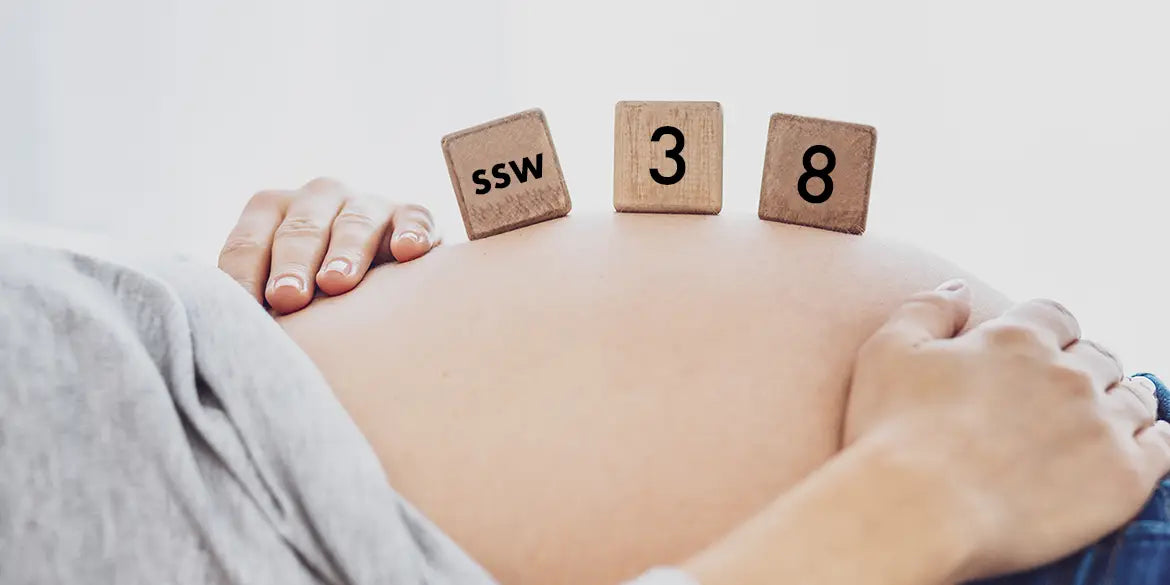


In week 38, there are only two weeks left until your baby's calculated due date. You are surely already very excited and can't wait to finally hold your baby in your arms. A pregnancy is a long journey that will end in the coming weeks with the long-awaited birth.
In our pregnancy calendar, we summarize how your baby develops in week 38 and why you now feel its movements significantly less. We also discuss the size and weight and introduce you to typical symptoms in the last weeks before birth. In the process, you will also learn why the automatic baby hammock from swing2sleep is an enrichment in the weeks after birth.
Movement & development of your baby in week 38
You are in the 38th week of your pregnancy. In the past months, your baby has developed into a small human being who has been viable on its own for several weeks. If your baby were born in week 38, it would be a "full-term baby." This means that it is fully developed and is no longer a preemie.
Nevertheless, your baby continues to change in this week of pregnancy as well. Until now, your baby was covered in lanugo hair: it is now slowly losing this hair and fine hair is forming. The vernix caseosa is also receding and will be hardly present at birth.
At the same time, your baby's lungs also continue to mature. They are thus preparing for your baby's first breaths. In week 38, the lungs are already ready to go: so your baby could already breathe on its own. It also continues to gain weight this week and builds up fat reserves for the time after birth.
You have surely noticed that your baby has been moving significantly less in recent weeks. This is simply because there is hardly any space left in your belly. It lies deep in your pelvis, which restricts its freedom of movement. If you feel fewer fetal movements, there is no reason to worry.
Size & weight: This is how big your baby is in the 38th week of pregnancy
Your baby will be born in the next few weeks and is already perfectly prepared for it. Its organs are mature and it has already built up enough fat reserves for the time after birth. By now, your baby weighs approximately 3,000 to 3,200 grams. Babies do not follow specifications: so it is quite possible that your baby is slightly heavier or lighter. Small differences are completely normal.
This also applies to the size. As a rule, babies in week 38 are around 49 centimeters tall. It will only grow a few more centimeters until birth. Most babies are between 50 and 54 centimeters tall at birth. In week 38, your baby's size resembles a stalk of rhubarb.
Are you ready for the birth? In week 38, it could start any minute and your baby could be on its way. If you want to offer your baby a secure nest after birth, then the innovative automatic baby hammock from swing2sleep is the best choice. It is a proven sleep aid that has a calming effect on your baby and is intended to improve its sleep.
How you are doing shortly before the birth
In week 38, you are close to giving birth. You likely notice this in your body as well, as it is slowly adjusting to bringing a baby into the world soon.
For example, your cervix is likely already changing this week. Although you don't have real contractions yet, your cervix may already be opening now. For other pregnant women, this may only happen shortly before birth. Just like your baby, your body does not follow a strict schedule.
In the 38th week of pregnancy, the mucus plug can also detach. This seals your cervix during pregnancy. Before birth, it detaches, which you can recognize by increased discharge. If the mucus plug detaches, the first contractions will likely start soon.
You will likely no longer have descending contractions in the 38th week. Your baby should already be lying deep in your pelvis by now. So it could be that these are pre-contractions or already labor contractions. These occur at regular intervals and increase in intensity. If the contractions occur every five to ten minutes, then you should make your way to the hospital or contact your midwife.
Symptoms & signs in the 38th week of your pregnancy
From the 38th week of pregnancy, it can start any minute. Around 70 percent of all babies are born in the ten days before or after the calculated due date. So it is quite possible that your baby will already be born in the 38th week.
For many expectant mothers, the last weeks of pregnancy are particularly exhausting. This is due, among other things, to the following symptoms:

Diarrhea & nausea
Your uterus contracts during the first contractions. These movements can affect your digestion, so diarrhea is not uncommon. The strong pressure on your stomach can also trigger nausea.

Back pain
Your baby now weighs around 3 kilograms. This weight puts an increasing strain on your back. Many pregnant women find it difficult in the last weeks before birth to find a comfortable position and relax their back.

Nervousness
Shortly before the birth, you are likely very tense nervously. Especially with the first child, you don't know what to expect and the pain from the first contractions further attacks your nerves. Try to stay calm despite the tense situation and prepare yourself mentally for the birth.

Fatigue
Your body is under great strain in week 38. So it is quite possible that you are very tired and also want to sleep during the day. Follow this urge: you will need your full strength for the birth.
Perhaps you already have a feeling that the birth will start soon. Around the calculated date, you should try to rest extensively and listen to the needs of your body. You should observe yourself closely to recognize the first signs of an upcoming birth.
This also includes the water breaking. In this process, the amniotic sac that surrounds your baby during pregnancy ruptures. The amniotic fluid usually does not leak out completely, as you might know from movies. Many women only lose a few drops of amniotic fluid. If you notice an unusual discharge, you should therefore contact your doctor or midwife.
If, on the other hand, the last weeks of your pregnancy pass quietly, then you can devote yourself to further preparations for the arrival of your baby. The automatic baby hammock from swing2sleep has already convinced 170,000 families. With gentle up and down movements, it rocks your baby to sleep. These movements have a calming effect on your baby: this reduces stress for both babies and parents.
This is important shortly before the upcoming birth
In the 38th week of pregnancy, you should mentally prepare yourself for the fact that birth could start at any time. To do this, it's best to go through all the details once more: who will accompany you, how you will get to the hospital, and what else is important. Your hospital bag should be packed by now and the infant carrier for your baby should be stowed in the car.
It can also help you to go through all the details from your birth preparation course once more. Remember the breathing techniques that were shown to you there. In this context, you should also reconsider in which position you want to bring your baby into the world. In a natural birth, you have a wide variety of positions to choose from. It is important that you make this decision yourself and listen to your body.
C-section in week 38
In Germany, about 30 percent of all children are born by C-section. If a planned C-section is also to be performed for you, then this may be carried out in week 38 or 39. The doctors will only deliver your baby by C-section as late as possible, because every day in your belly is important.
If a C-section is performed for you, the doctors will inform you about all risks before the procedure. As a rule, you arrive at the hospital one day before the planned procedure. On the morning of the C-section, you remain fasting before you go to the operating room. It is decided in advance whether you will receive general anesthesia or spinal anesthesia.
The situation may be frightening for you: for doctors, however, a C-section is a routine procedure that takes only 5 to 10 minutes without complications. For this, a cut about 15 centimeters long is made just above the pubic hair line. Subsequently, the layers underneath are also severed before your baby can be lifted out through the opening.
After a C-section, mothers and their babies often have to stay in the hospital a little longer. The scar must first heal before you are allowed to go home after four to five days.
So that your baby can sleep relaxed after birth, it needs a suitable sleeping place. In the automatic baby hammock from swing2sleep, it lies snugly enclosed in a small nest. Your baby knows this feeling from your belly and can therefore calm down more easily. The exciting time with your baby will thus be significantly more relaxed for all of you.
Automatic baby hammock from swing2sleep: Recommended by midwives and osteopaths
After delivery, an exciting time begins for you and your baby. The automatic baby hammock from swing2sleep stands by your side as an intelligent sleep aid. Our smarla automatic baby hammock rocks your baby silently to sleep. The silent motor has early wake-up detection. The cradle automatically adjusts its movements to your baby's movements to rock it back to sleep. You can also control the motor via an app and will be informed if your baby wakes up or moves strongly.
In the process, you can adapt the complete set to your needs. You have various mounting options for the cradle to choose from. Most popular are our two stands, with which you can set up the automatic baby hammock anywhere in your apartment. For a lot of flexibility. For the color of the hammock, you choose between beige and gray.
With the automatic baby hammock from swing2sleep, you offer your baby a natural sense of security in a cozy closeness. The hammock is made of 100% organic cotton and is therefore particularly skin-friendly. Thanks to its numerous advantages, our automatic baby hammock is recommended not only by parents but also by midwives and osteopaths.