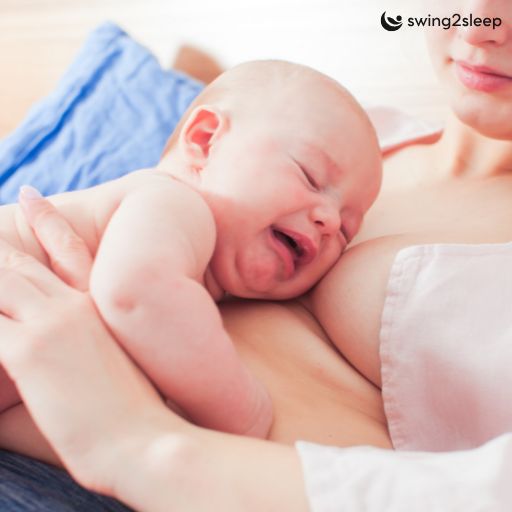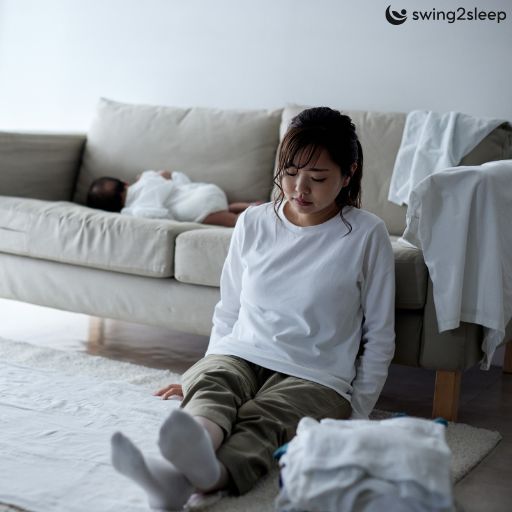



It can be quite discouraging when your own baby won't stop crying and screaming. You worry that something might be wrong with your child, that your parenting skills aren't enough, or that you'll never manage to build a relationship with your baby.
But you can do it! This article is intended to make it even a little bit easier for you.
No matter what you do – the baby won't stop crying
Even though you know that every baby has its own personality, it still hits you like a blow every time other parents report how friendly, peaceful, and easy-care their babies are.
However, comparisons are not useful because they lead nowhere and only leave you feeling frustrated.
It can take some time before you and your baby get into sync, but in the end, you will see how rewarding the extra work has been.
For stressful situations, however, you need strategies that you can use when, for example, the baby won't stop crying or doesn't react to you. Here you must keep the situation under control, even if you are tired, frustrated, and irritable. Only with a cool head can you determine where the problem lies each time and solve it if necessary.
How do I cope with a non-responsive, crying baby?
Recognize your limits. Pay attention to internal warning signs when you feel overwhelmed. The sooner you know where your strength ends, the earlier you can take counter-measures. If everything becomes too much for you and things are getting out of hand, then get help, take a break, and let your partner take over for a moment. Create moments that bring you joy. You need a lot of strength to take care of your baby, and you have to draw this strength from somewhere.
Play for time. As exhausting as the baby's crying may be – the end is in sight. From the sixth week onwards, the crying decreases for most babies. Have some patience and hang in there.
Accept any help. Say yes when help is offered to you. You can really use every helping hand. Be it with housework, for babysitting, or cooking. If possible, connect with other parents as well. In this way, you can provide each other with help and find someone to talk to who understands you.
The illusion of perfection
Parenting is not about perfection. It is simply impossible to be present and attentive always and at all times, especially with a baby that demands your attention around the clock. For a healthy and secure bond, according to experts, it is enough if you spend a third of your time with the baby. Don't worry too much about whether you are doing everything right. Instead, try to relax and enjoy the moments when your baby is not screaming.
The baby doesn't cry without a reason
There can be many reasons why your baby cries; after all, it is their only way to express themselves. Only in this way can they attract attention and show what they need. In the beginning, every cry may sound the same, but over time you will develop an ear for what the baby wants to tell you with their crying each time.
The most common reasons for crying
1. Sleepiness or tiredness
2. Full diaper
3. Hunger
4. Sensory overload from noise and activities
5. Colic, acid reflux, or intolerances such as lactose intolerance or other allergies
6. Pain or illness
7. Gas
8. Fear of strangers or general anxiety
However, about 20% of babies cry particularly much – seemingly for no reason. They often suffer from a regulation disorder, which means they find it difficult to process the mass of new impressions gained during the day. Overwhelmed in this way, they sleep worse and sometimes cry incessantly. We have dedicated an extra section to these babies below.
Does your baby seem unreachable or indifferent?
Babies express a grievance with their crying, and they will only stop when it is resolved. However, there are also babies who simply shut down their emotions when they get too upset. As a result, they seem distant, uninvolved, and inaccessible. Such a baby initially seems particularly easy to raise because they make a quiet and pleasant impression. However, a baby who does not react to their environment urgently needs help. In such a case, it is best to call your pediatrician immediately.
NEVER! SHAKE! THE! BABY!
One of the greatest tragedies in a young family occurs when a caregiver, under the never-ending barrage of baby cries and the effects of severe sleep deprivation, simply loses their nerve and shakes the child in the heat of the moment. This can lead to so-called shaken baby syndrome. A baby's neck muscles cannot yet counteract these strong impulses. It can lead to bleeding in the brain, which can result in permanent damage and even death.
Babies are already little personalities
Every baby perceives its environment differently and expresses itself in an individual way. Added to this are very specific likes and dislikes. Your offspring is a personality all of their own from day one. This can manifest itself in one baby liking to be held, while another starts screaming as soon as they are picked up. Babies also react differently to wet diapers, as some sound the alarm immediately while others act as if nothing is wrong. If you have good powers of observation, you will get to know your offspring quite well quite quickly.
Pay attention to the signals
− Mood swings: How does your baby's mood change throughout the day or during naps and meals?
− Reactions to changes: How does your child deal with changes? Babies often send signals that we adults don't even notice. An unforeseen change may upset your baby very much. It may quickly become overwhelmed with too many new impressions.
− Different types of crying: At first, your baby's crying will sound pretty much the same to you, but gradually you will be able to distinguish "hunger crying" from "tired crying," for example. Distinguishing features include things like volume, pitch, and intensity, but body language and facial expressions also play a role: an arched back, a scrunched-up face, and eyes that are slightly closed to keep out the light. Hands clenched into fists, rubbing their eyes, or even hyperactive movements are all signs of your baby's respective physical and emotional state.
Calming an unreachable, agitated baby is a special challenge. Reading the signs requires all your attention and perception. Don't be discouraged if it takes a little longer to get the hang of it. Your baby will keep going until you understand!
The 5 S Method: A happy child is a quiet child
In the early 2000s, the US pediatrician Dr. Harvey Karp published a book that gave many desperate parents new hope. It contained a method that could calm even persistently crying babies in just a few moments.
The components of this procedure, known as the 5 S Method, are:
− Swaddling: Wrapping the child tightly, known as swaddling, is actually an ancient tradition. It is thought that the constant contact transports the child back to their time in the womb, making it easier for them to relax. However, be sure not to wrap the child too tightly. In addition, the legs should still have a certain amount of room to move.
− Side/stomach position: The side or stomach position is the baby's comfort position. When lying on their back, they can get the feeling of falling, especially in stressful situations. They feel safe lying on their stomach. However, this position is not entirely safe for children when sleeping. Therefore, they must always lie on their back when sleeping.
− Shushing sounds: It was not quiet in the womb. The child was constantly surrounded by noises, e.g., digestive and breathing sounds, muffled noises from the outside world, voices, but above all the pumping of the heart and the rushing of the blood. This sound is similar to so-called white noise, which we also know from the sound of waves or rustling leaves. This sound has a calming effect on all people. To simulate it, you can simply make a "shhhhhhh" sound. Interestingly, babies also find a hair dryer, an extractor hood, or a vacuum cleaner calming.
− Swinging: In the womb, the child was also constantly in motion. The mother's movements caused the fetus to swing up and down and back and forth in the womb. If the newborn is rocked or swung, this also creates a reconnection that makes them feel comfortable and secure. This can best be simulated with a swing2sleep. Thanks to an automatic baby hammock motor, the gentle up and down movements only stop when you take your child out of the hammock.
− Sucking: Sucking is an early childhood reflex and has a deep effect on the child's nervous center. By the way, the mother's breast works even better than any pacifier or bottle.
Keeping an eye on your own feelings
Many parents blame themselves for the fact that their child cries continuously. They believe they are failing at raising their baby.
On the one hand, this is unfounded because the phenomenon is widespread and well-documented; on the other hand, such feelings of guilt will only put further strain on your relationship with the child. It becomes harder for you to stay calm, your frustration tolerance drops, and furthermore, babies are sensitive mood detectors. They feel your distress and absorb it directly. This makes your attempt to calm the child much more difficult.
How to stay relaxed while calming your baby
Don't forget that your baby has feelings. Babies are also people with feelings like joy, happiness, sadness, and anger. If you find it difficult to react and respond to your child, they will adopt this trait from you. This can lead to attachment disorders and emotional coldness. It is best to imagine your child as a person with special characteristics right from the start.
Take time for yourself. Such advice may feel like mockery at first, but it is actually very important. Anyone who is constantly under pressure will find it harder to react confidently in a critical or particularly stressful situation. Therefore, it is important to let off steam regularly. Coordinate with your partner, involve friends and relatives, or hire a babysitter. There will be some solution. This way you can recharge your batteries and stay calm when your little sunshine goes completely crazy again.
A swing2sleep could also be worthwhile for you here. With its gentle up and down movements and cozy closeness, this Automatic baby hammock provides a sense of security just like in the womb. The baby calms down without you having to constantly push the hammock. This way, you finally have a little time for yourself again.
Use the emergency brake if you have to. This can take many forms: count to ten, walk around the house once, breathe deeply in or out. Whatever it looks like for you: take a moment out of the acute situation to collect yourself and then be able to continue.
Think of a mantra. Mantras can be words, sentences, or sounds that you repeat over and over so that a message sticks in your subconscious. It should provide inspiration and strength. Parents usually talk to the baby anyway when they try to comfort it. Then you can also use your mantra. Simple messages like "It's hard, but doable," "just breathe," or "everything will be fine" can bring amazing results.
The contact phases in the first 18 months
Especially if your baby seems disinterested and unresponsive or cries continuously, it doesn't hurt to know a few things about how your child's communication develops in the first 18 months. This helps you keep your expectations realistic, facilitates making contact, and subsequently the establishment and deepening of your bond.
1. Attention and regulation (at 3 months of age)
Attention and regulation always go together because a restless baby is not attentive and therefore cannot interact with you.
The baby has different phases, e.g.: it is calm and not crying, it is attentive and not sleeping, it shows interest in other people but not in you.
Simply follow your baby's lead. When it gives you attention, respond with gentle touching and stroking, soothing words, or playful facial expressions.
2. Shared joy (at 3-6 months of age)
Sharing joy with your baby creates a link between sensory experience (things your baby hears, feels, and sees), security, and love.
Your baby tries to engage with you and participates in the exchange of gestures, smiles, sounds, and movements. However, your baby might also need a break in between.
When your baby wants to communicate or play with you, play along! And when it wants to take a break, use the time to wind down.
4. Communication (at 4-10 months of age)
During this time, interaction with your baby becomes increasingly sophisticated. The repertoire of sounds, facial expressions, and gestures is steadily growing. Dilated eyes, nonsensical clapping, giggling, and pointing with a finger are signs with which the baby shows you that it wants to play or needs something.
Continue to pay attention to the signals, facial expressions, and gestures and react to them. This will have a positive reinforcing effect and further encourage the child. In this way, active communication gradually gets underway.
5. Various gestures and problem solving (at the age of 10-18 months)
Your baby's new skills such as crawling, pointing and perhaps even walking should lead to a deeper bond and ever-improving communication. Your child begins to combine the new ways of moving with their existing vocabulary in order to solve problems in this way. For example, they walk to the chair at the table to show that they are hungry, or point to something they cannot reach.
You then show your baby with your own words, gestures and facial expressions that their message has been received.
Three-month colic and regulatory disorders
In the past, excessive, inconsolable crying was attributed to so-called three-month colic. It was assumed that the infant's immature digestive system led to painful flatulence, which was then the cause of the crying.
Today, this idea is outdated. Regulatory disorders are now blamed for the crying fits. This means that these are particularly sensitive souls who cannot yet regulate their emotions and are particularly susceptible to sensory overload.
Affected children are popularly known as high-need babies.
What to do about regulatory disorders?
If your baby cries excessively, your first step should be to see a pediatrician to rule out any organic causes. If it really is due to a regulatory disorder, your baby is a sensitive little soul and needs fixed routines and as few external stimuli as possible. In addition, a lot of physical contact is required with these children. They need security and a sense of safety. In general, babies should not be left to cry, but with these children this aspect is particularly important. In the first few weeks, they must be provided unconditionally with everything they need: food, attention, physical contact, love, etc.
This can be exhausting, but with a baby wrap, you always have your child close to you and also have your hands free. If you can't or don't want to carry the child, a swing2sleep can step in for you. With its gentle up and down movements and the cozy tightness in its hammock, your little one feels as secure as in mommy's belly. Especially during a nap or at bedtime in the evening, a swing2sleep is a huge relief.
And the best part: you finally have a few minutes for yourself again.
Help from outside
Only those who have had a high-need baby themselves can truly appreciate how great the burden is for the parents concerned. That's why many feel misunderstood and alone in this situation. However, it can only do you good to break through the isolation in this situation, talk to experts or others affected and get advice or practical help.
A good place to go in such cases are crying clinics. There, the children are medically examined to rule out physical causes, and the parents also receive support and advice. They can now be found almost everywhere.
In our Facebook group "High-need babies" you can quickly get in touch with others affected. You can exchange experiences, vent your frustration, get tips, and perhaps friendships will even develop so that you can also support each other in everyday life.
Further assistance is offered by Emotional First Aid, for example, and you will also find valuable information and tips and tricks in our blog to help you through your everyday life with a high-need baby. Over time, we have accumulated so much knowledge that we have even written a guide. You can download it for free here.
We very much hope that you were able to benefit a lot from this post. If you liked it, please share it with your contacts!