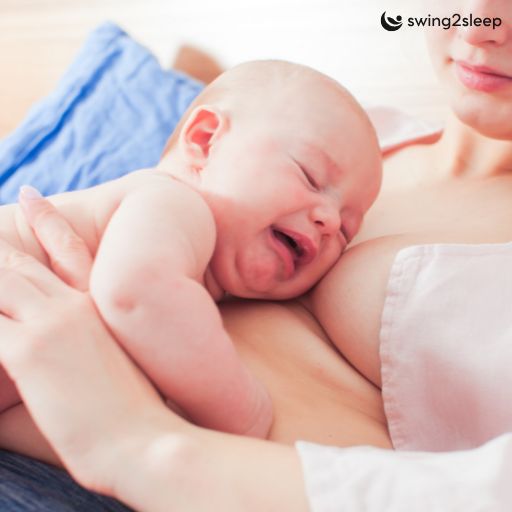



Science is a great thing. It explores the otherwise incomprehensible, discovers the unknown, and finds solutions for what was previously unsolvable. New theories are constantly being developed, questioned, discarded, and rethought. But what is good and sensible in the natural sciences causes confusion in educational science. Suddenly, something completely different is constantly touted as the best thing for the child. Generations get into arguments about how best to raise a baby instead of supporting each other. Often, this revolves around questions like "Comfort them or let them cry it out?". Yet every mother is actually equipped with an internal compass and the perfect tools. Her intuition.
Letting them cry goes against intuition
Anyone with a problem looks for solutions.
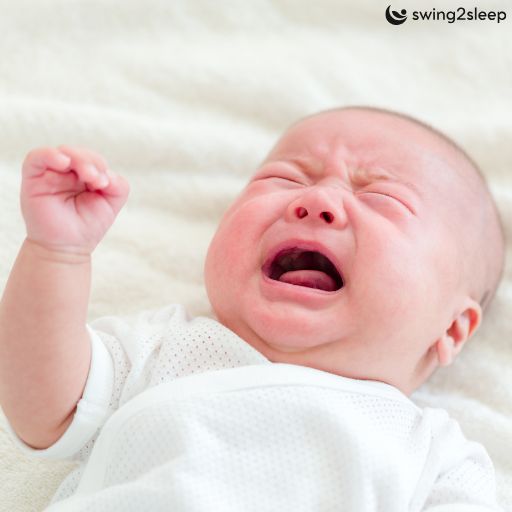
Anyone who has a colicky baby has a huge problem. Often, despair has already set in by the time parents start scouring the internet or bookstores for answers. We are particularly prone to believing people in white coats who say clever words into the camera with a smart expression or write clever books. We want a solution that works. And if it is even scientifically confirmed, it must work.
The trouble is that science is never finished and often contradicts itself. Especially in child-rearing, it is striking how much pedagogical dogmas adapt to the zeitgeist. In Prussia and the Third Reich, children were raised differently than in the 1970s. Yet children's needs have always remained the same. They are still the same as they were thousands of years ago.
Now, parents and especially mothers have been equipped with a natural sense for at least as long. Instinctively, they know what is right for the child at that moment. We call this intuition or: maternal instinct.
Mothers suffer when their child suffers. Therefore, when a study states that children do not suffer if their parents simply let them cry and, at best, try to comfort them with words without physical contact, it goes against an ancient instinct.
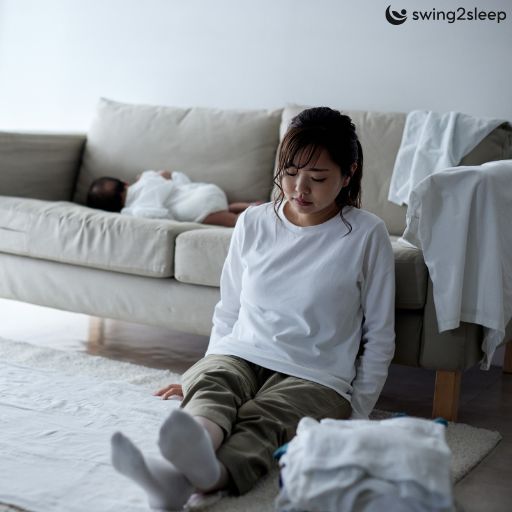
Not only the child suffers from this, but the mother does too.
Trusting your intuition::/H3
Since the Enlightenment, in which the primacy of ratio—the rule of logical thinking—was established, instincts or intuition have had a hard time. Intuition has the scent of the unenlightened, the primitive, or even the esoteric. In reality, however, it is Mother Nature's answer to the crying baby. It is the millennia-old programming to provide the child with everything and protect them from harm.
The only problem with intuition is that it is a rather quiet voice that is all too easily drowned out by the constant chatter of the mind.
To perceive it, the inner roar must subside. If you want to listen to your intuition, you have to take a moment, breathe deeply, and find peace for at least a few minutes.
Then you give this inner voice the chance to be heard. And while science speaks with many voices, changes its standpoint frequently, and all too often contradicts itself again after a short time, intuition still says the same thing after thousands of years.
One can view this as anti-science or backward-looking.
But one can also take the position that babies should not be guinea pigs for short-lived scientific theories.
This post was inspired by our Facebook group "Schreibabys". In this group, you can also network, receive valuable tips, and exchange ideas with others affected.
Sincerely,
Your Maik Schwede
swing2sleep – the automatic baby hammock
Baby sleeps in seconds – Mom has peace for hours