

Your baby is now 10 months old and time is flying by. It feels like they just smiled at you for the first time and you celebrated their first roll, and now your little one is already cruising along the sofa and furniture, wanting to pull themselves up on everything and explore their surroundings.
They probably don't think much of help anymore – the desire for autonomy is great and your baby has not only discovered their own will, they are also loudly demanding it. You have already reached many milestones in these 10 months, and new ones will follow in this new month of life.
The development of new skills and an irrepressible urge to move are at the forefront of baby's 10th month. This is a challenging time for you as parents, because in a moment of inattention, children crawl off into new adventures as fast as the wind.
But the closeness of mom or dad is still sought and needed. After the 9th month, you are surely wondering what the new month has in store for you and your baby. You can find an overview of your baby in the 10th month in this article.
What's new in baby's 10th month
What should a 10-month-old baby actually be able to do and what do they learn in this new month of life? The tenth month is primarily about movement. Your baby can now probably sit, crawl, scoot, or roll and might even be taking a few steps along the furniture.
The muscles are developing, and so your baby is gaining completely new motor skills. Now the window for the U6 check-up with your pediatrician also begins.
Between the tenth month and the first birthday, your pediatrician examines your baby's motor skills and emotional maturity; additionally, the STIKO recommends the third hexavalent vaccination. You should therefore make the appointments for the examinations in good time.

Sensory development at 10 months
In the tenth month, motor and sensory development work closely together. Your baby's sense of touch is developing, and so new impressions are stored in the brain. Your baby can also now better recognize and categorize connections.
For example, they now know that a banana must first be peeled and that the flesh feels firm, at least until you mash it. What looks like random playing with food to the outside world is actually the exploration and learning of different textures and the logical consequences of actions.
It may be difficult at times, but when you parents let your baby explore with all their senses, you are helping them experience important steps in their development.
Your baby falls down remarkably often in this month of life. On the one hand, it is due to the lack of coordination of arms and legs when crawling, because sometimes the head is faster than the limbs. But your baby will also often land on their bottom from a standing position, especially in the beginning.
Don't worry, both are important for further development and most children cry, but do not seriously injure themselves. However, they are training their sense of balance, which is crucial for later walking. Make sure your home is safe for your little beginner walkers and that all corners and edges do not pose a risk of injury.
Motor development – Baby at 10 months
Motor-wise, there is a lot going on with your baby at 10 months. Your little one can probably hardly be held back, and all of your baby's energy is invested in crawling, pulling up, sitting, and standing. But fine motor skills are also experiencing a new developmental leap, as your baby is now learning the pincer grasp.
The muscles of the hand are now able to grasp even small objects with the thumb and index finger. This opens up completely new possibilities for your baby in play, but caution is also required now, as small objects can sometimes end up in your baby's mouth and your little one can choke on them.
Life on all fours is coming to an end. Your baby wants to stand, walk, and no longer just lie on the floor. With this new perspective on the world, they are now getting an overview and want to explore their surroundings.
Resist the urge to walk them by the hand and instead encourage your child to continue performing their movements independently. This is healthier for your baby's muscles, even if their will is probably already more advanced.
Your baby's language development in the 10th month
Your baby is now able to use two-syllable words and likes it when they can have conversations with you in their baby talk. The tenth month also marks the first time your baby starts making contact with other children.
If you attend playgroups or other meeting opportunities with your baby, you have surely noticed that babies have their own ways of communicating with each other.
You can help your baby by giving every object a fixed name and talking to your baby, even if you can't yet understand what they are answering you.

What a baby should be able to do in the tenth month:
The development of children is naturally different; not every baby at 10 months is like the others, and that's a good thing. Comparing the development of children is not productive, and you can be sure that most babies learn exactly the skills they need most urgently in that phase of their lives.
For some babies, language development is at the forefront, while for others, motor development is more advanced. To give you a good overview of what the average baby can do in the 10th month, we have created this overview for you.
- In the tenth month, babies can recognize, remember, and repeat movements. So your baby can now wave and clap if you demonstrate it to them. They will also observe you and your movements closely and, for example, guide a spoon quite accurately into their mouth, because they have picked that up from mom and dad.
- At 10 months, your baby understands sequences and that many processes have a system. This leap probably affects your baby's behavior. Does your little one seem cranky, dissatisfied, and is particularly clingy? This suggests the seventh growth spurt. Hang in there, it's just a phase.
- You might have already noticed that your child's stranger anxiety is slowly subsiding. In addition to mom or dad, your baby is now developing relationships with other people.
10-month-old baby: Sleep, nutrition, and encouragement
The new month of life brings a lot of change. Your baby is becoming more and more of a toddler, and it's time to say goodbye to the baby months. You will notice not only physically that your child is losing their baby fat.
In their personality, too, they are becoming more and more of a little person with their own personality and a strong will. Your 10-month-old baby has already turned your life upside down, but you are surely a well-coordinated team by now.
Have you wondered how much a baby at 10 months actually sleeps? And should you actually offer your baby help when they want to venture their first steps? We answer these and other questions for you below.
How your baby sleeps in the tenth month
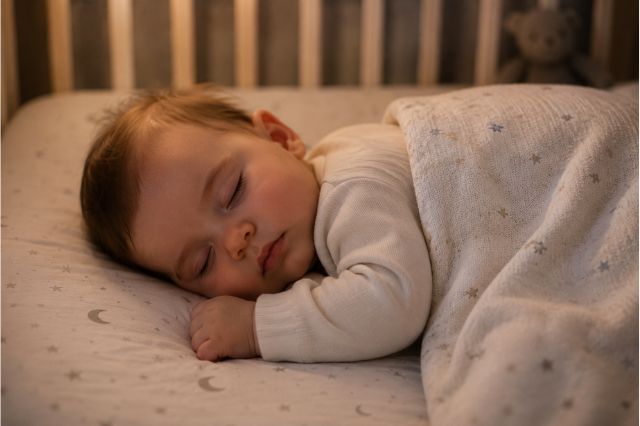
If your baby still needed several naps a day until their tenth month, their sleep behavior will probably change in the new month of life. Instead of two to three small naps, most 10-month-old babies only take one, somewhat longer daytime nap.
At night, your baby will sleep between 8 and 12 hours, though very few children manage this in one go. If your baby wants to nurse at night or asks for a bottle, that is nothing unusual.
The desire doesn't always have to do with hunger, but rather with a comforting feeling of closeness. Nevertheless, it is absolutely fine to provide your little one with this closeness through bottles or nursing.
10-month-old baby – What's on the menu
A 10-month-old baby is able to pick up small objects using the pincer grasp and move them accurately to their mouth. This expands your baby's menu to include many small foods such as peas.
These can now be picked up with the thumb and index finger, but be careful: this new skill also carries the risk that things end up in your baby's mouth or nose that have no business in their diet and, of course, especially not in their nose.
Make sure that when serving finger food, you halve round foods like blueberries and grapes to minimize the risk of aspiration.
How you can encourage your 10-month-old baby
Special encouragement for babies is not necessary, but there are many options for games and playgroups that can help you accompany your baby's development.
Baby gymnastics or PeKip are great ways to promote your baby's social life and also for you to get in touch with other parents. However, if you prefer to stay among yourselves, age-appropriate toys are just as helpful.
Seeing the world through your baby's eyes is a wonderful and new experience for you as parents. Even if some days and especially nights are challenging and exhausting, it is a time full of adventure and wonder.
The baby time passes far too quickly, and in just a few months, your little baby, who was just born, will become a toddler. We hope we were able to give you a good insight into what to expect in your baby's tenth month. And now on to the eleventh month!
What should babies be able to do at 10 months?
Many babies sit securely, crawl or scoot, and pull themselves up on furniture.
Typical milestones include the pincer grasp (thumb and index finger), reacting to their own name, and lots of "baby talk."
Important: Development is individual. Not every baby shows everything at the same pace.
Why is my baby in a difficult phase at 10 months?
Around the 10th month, major developmental steps often occur. This can affect sleep, mood, and the need for closeness.
Many babies become more clingy, protest more strongly during separation, and wake up more frequently.
Teething, new routines, or more stimuli in everyday life can also intensify this phase.
What are the warning signs in a 10-month-old baby?
You should have it checked out if your baby loses skills or seems very listless over a long period.
A lack of reaction when spoken to, noticeable drinking or eating problems, or persistently weak eye contact are also reasons to seek medical advice.
If your gut feeling sounds an alarm, a quick clarification is always sensible.
Which spurt occurs at 10 months?
Many parents observe a spurt around the 10th month related to mobility, understanding, and bonding.
Typical signs include more separation anxiety, more restless sleep, and a strong need for closeness.
This often feels like a step backward, but it is frequently development in action.