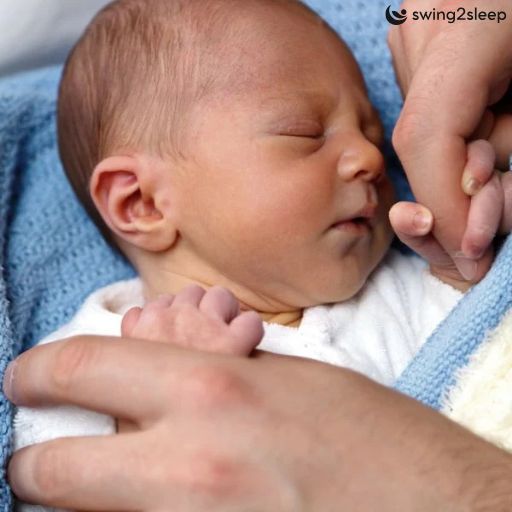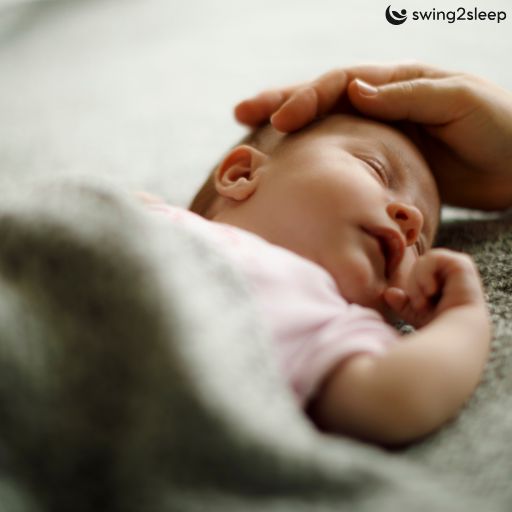
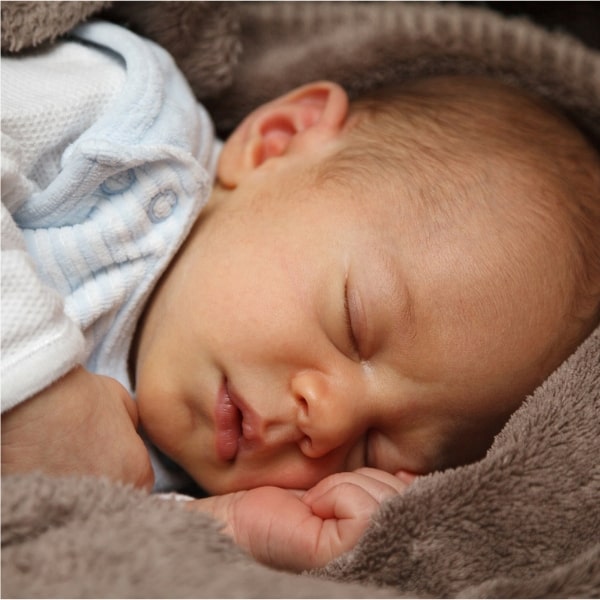


Can you also not get enough of watching your baby sleep? Most parents feel the same way. It is simply adorable to watch: how they smile, frown their little forehead, twitch their arms, and even make real faces.
Many parents ask themselves: Is our baby actually dreaming? Do they dream just like we adults do, and do they dream at all?

Do babies dream at all?
It is considered certain that babies dream. What about, however, will probably always remain their great secret.
In fact, it has been found that babies have more dream phases than adults. While the latter only spend about 20% of their sleep in the REM phase responsible for dreams, for babies it is a full 50%.
Babies even dream before birth
From everything we know, babies even seem to dream before birth: From the 6th or 7th month of pregnancy, REM phases have been detected in sleeping fetuses.
Despite this fact, science assumes that these dreams have no tangible content.
How can you tell that the baby is dreaming?
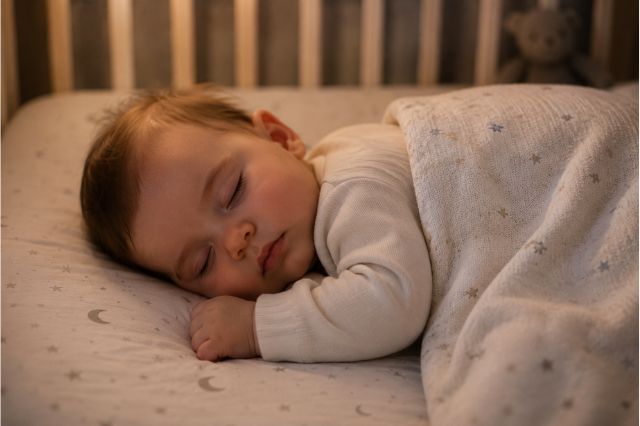
Perhaps you are wondering how you can tell when your baby is actually dreaming. It's not that difficult: The REM phases and the non-REM phases can be easily distinguished. During the non-REM phase, the baby breathes steadily, deeply and regularly. Sometimes this sleep is only interrupted by light sighs. They lie completely still and make at most slight sucking movements with the mouth. It can also happen that they briefly twitch. In this phase, the baby is not dreaming.
In the REM phase, however, the eyes move back and forth under the lids. Here, too, the baby lies still and sometimes twitches. However, they may breathe rather irregularly. This is exactly the time when your baby is dreaming. They make more noises, babble, sometimes giggle quietly or sigh.
Dream phases become fewer
From the age of about one year, your baby's dream phases gradually become fewer. Outside of the REM phases, their sleep is deeper and calmer. The older your child gets, the more their sleep will resemble that of adults.
Dreaming is important for babies
Dreaming is important because it is how we process the day's experiences. This applies even more to babies, because everything is truly new to them and all neural connections are still forming. Compared to adults, they have to cope with many times more new impressions. Therefore, your baby has many REM phases in which sleep is somewhat more restless. This is no cause for concern – quite the opposite: your little sunshine is learning while they sleep.
What do babies dream about?
One can only speculate here: it is assumed that babies, just like us adults, process what they experience during the day in their dreams – for example, the last breastfeeding, cuddling with mom, or the last bath. It is known that babies and toddlers do not yet dream such complex stories as we adults do. Rather, they dream of individual events or even just still images. This is not surprising, as babies still lack the understanding of contexts and the complexity of thought processes. Their dreams are presumably more about things seen, heard, smelled, or felt, about images, moods, and atmospheres.
Unborn babies, on the other hand, might dream of an unknown sound that they perceive in the womb.
Can babies already have nightmares?
Some parents have the feeling that their child might be dreaming something bad. Can this actually already be the case with a baby? Some researchers assume that children at this age cannot yet have nightmares. Their argument: nightmares only occur when there has been stress or traumatic experiences, which babies are generally not yet confronted with. However, this is a conjecture based on further conjectures: how children dream (see above), what is traumatic or stressful for children, and exactly how they process such burdens. In fact, one could argue that this thesis stands on shaky ground and we end up back at the starting point: we simply do not know. Therefore, the fear cannot be easily dismissed.
The theory that nightmares occur more frequently between the 2nd and 4th year of life is better supported. The research situation is more solid because children at this age are already able to communicate their dreams. In addition, they are exposed to a flood of new impressions again during this phase of life due to starting kindergarten. And cognitive development progresses, which means that they absorb the events around them more consciously. Accordingly, more complex plots and situations also develop in dreams.
Organizing the child's sleep better
No child is born with a perfect sleep rhythm – while that would certainly be the wish of all parents, it unfortunately remains unfulfilled. Sleeping is also a skill that children first have to learn. In the womb, they were not subject to any patterns in this regard – in a way, they were in a timeless space.
A wake-sleep rhythm can therefore only gradually develop after birth. From the age of 3 months, a tendency towards more night sleep gradually becomes recognizable.
Napping also plays a role in how well and how long your baby sleeps at night. When they are about half a year old, you can influence your little one's nightly sleep needs to a limited extent by regulating their daytime naps.
Sleeping during the day or at night?
The long-term goal should, of course, be that your baby eventually only sleeps once or twice during the day, but for several hours at a time at night. However, you have to slowly feel your way in this direction.
A baby of about 3 months will sleep less and less frequently during the day and more at night. data-contrast="auto">Usually they already sleep twice as much at night as during the day. That is already a big step in the right direction.
The next step comes at about 6 months: Normally, the morning and afternoon naps now become longer, but the child no longer sleeps several times spread throughout the day. At night, they might now even sleep for 10 or 11 hours, although not yet at a stretch.
Once your baby is one year old, the two naps they previously took throughout the day may be reduced to one midday nap. This, however, can sometimes be quite long: up to three hours, depending on the child and the duration of their nighttime sleep.
How can you (to some extent) control your baby's sleep?
At some point, many parents realize that it is hard to get their child to bed in the evening if they slept quite late in the afternoon. Due to the nap in the afternoon, the little one is simply not tired yet in the evening. For a child of six months, this is generally not a problem yet, but from the age of one year, the midday nap can already have a massive impact on nighttime sleep.
That is why your baby should have been awake for at least four hours before going to bed in the evening. If they fall asleep again at 5 PM for one hour, it could be tight for nighttime sleep at 8 PM.
You should therefore ensure that your child's last nap takes place as early as possible. If you miss the timing for the midday nap, you can still try to save your night's rest by keeping the baby awake. However, that is also a challenge of its very own kind. Good luck with that!.
With the last tip, we return to dreams:
It would be ideal if your baby is only exposed to various stimuli during the day and not at night. Such stimuli at night can lead to the baby sleeping more restlessly due to intense dreams. If, on the other hand, your child is largely shielded from external stimuli at night, such as in the swing2sleep, they can sleep more peacefully and also learn to sleep through the night more quickly.
The team at swing2sleep wishes you pleasant dreams and a restful sleep.