

How wonderful it would be if a baby were able to calm themselves down sometimes when they cry or are distressed. Then you as parents wouldn't always have to be there immediately and could get better rest, especially at night. In fact, there are babies who master this art very early on.
Others, however, will rely on support from mom and dad for a long time – through carrying, singing, cuddling, simply by providing comfort and security. This gives the child safety and emotional stability.
Can you teach a baby to a certain extent to calm down again without their parents? Clear answer: Yes and no.
Self-regulation: A difficult task for babies
Experts speak of self-soothing competence when someone is able to find their way back to a normal level during inner tension or stress. For a baby, this is significantly more difficult than for an adult.
When the baby feels discomfort, for example due to stress, it has no other choice but to express this through crying and fidgeting. This also makes it so difficult for the child to calm down again on their own. Some children succeed in this through sucking.
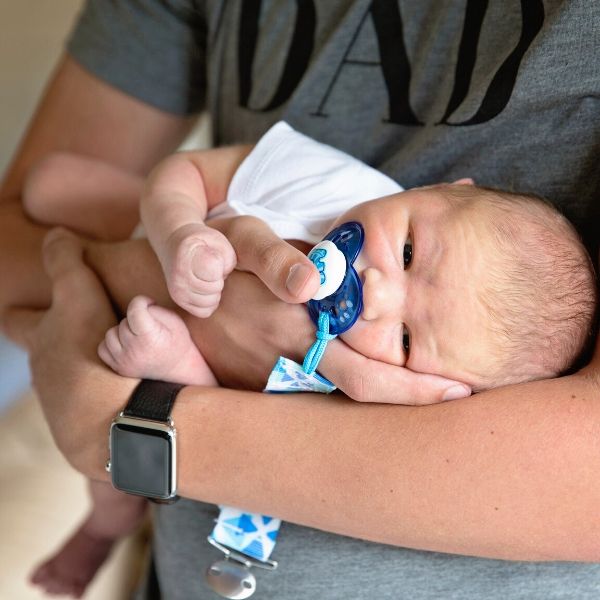
The innate sucking reflex serves not only for feeding, but also for soothing. Sucking on a thumb or pacifier therefore has a calming effect on small children.
However, they are not yet able to put the pacifier back in their mouth when needed and are therefore still dependent on your help.

Soothing strategies develop all by themselves
The good news: Your newborn's self-soothing competence continues to develop. Even if it is difficult for your baby to calm themselves down at the beginning of life, this will fortunately not stay that way. This skill develops gradually.
However, the child is dependent on your caring help, especially in the early days. This means they must be absolutely certain that you are there for them when they cry. You must therefore respond promptly to crying and comfort the little one.
In the process, stress regulation mechanisms are formed that will enable the baby to handle stressful situations alone in the foreseeable future. These mechanisms are of great importance for later life. They help the child in kindergarten, during school years and later throughout adulthood to manage critical situations on their own.
Basic trust is very important
This only works, however, if the baby can build a healthy basic trust in you. This happens when it knows that its worries and needs are taken seriously by you.
A healthy basic trust ensures that your baby develops good self-esteem and feels safe and secure. It is also an indispensable pillar for developing strong self-soothing skills.
Mastering self-soothing is a process that can take quite some time. With older babies from the age of six months, you can introduce it step by step. To fall asleep, you can first hold their hand, later you just sit next to them until they have fallen asleep. Eventually, it will work on its own.
Such gentle weaning processes will lie ahead of you several more times as you accompany your child.

Child should soothe themselves: Letting go is important!
For parents, it is true that they must learn to let go! The bigger your baby gets, the less it needs permanent physical contact with you. When it is lying on the play mat and starts to fuss, from a certain age it can also wait one or two minutes until Mom or Dad checks on it.
This means, put your baby down every now and then so that it even gets the opportunity to occupy itself. How is it supposed to soothe itself if the parents are always there immediately?
Even short separations from mom and dad can be helpful, for example, by entrusting the baby to grandma or a friend every now and then. This also teaches them that mom or dad don't necessarily always have to be around them.
Self-regulation means that the baby can better handle both small frustrations and short separations from the parents.
For some children, this happens faster, while for others it takes significantly longer than a year. Furthermore, self-regulation must always be considered in the context of the respective situation: A three-year-old child who falls and scrapes their knee will still seek the comfort of their parents even at that age.
If you support your child with love and patience from day one, they will build the necessary basic trust they need for healthy self-confidence. Then, sooner rather than later, they will be able to emotionally regulate themselves independently in demanding situations and become increasingly independent over time.
This doesn't happen overnight. In fact, it is a gradual process that takes place in stages until children fly the nest – and often even beyond that. But that's what parents are there for.
8 misconceptions about baby self-regulation
There are a lot of myths, rumors and alleged tips about baby sleep that you can actually safely forget. However, this topic is also complex, and for most parents it is almost always at the forefront during the first months and years. That's why we're clearing up the eight most common misconceptions here:
Romping around with the baby in the evening makes them tired
Unfortunately, that's not always true. Often you achieve exactly the opposite: your little one becomes even more wound up by the stimuli and is suddenly wide awake. Then they really can't fall asleep. Instead, you should let the day wind down quietly and start the night with evening rituals.
Don't let the baby sleep too long during the day, then they'll sleep through the night sooner
This isn't always true either. Sure – if your baby sleeps an above-average amount during the day, they might be more likely to be awake at night.
And yet: If you intentionally keep your baby awake during the day, they may be overtired in the evening and then find it even harder to fall asleep. Try to follow your baby's own sleep rhythm so they can sleep healthily.
If absolutely nothing helps: Put the child in the car and go for a drive
While it may be true in the short term that your infant actually falls asleep, in the long term you are more likely to reach a point where they might only fall asleep when they hear an engine noise. Moreover, this behavior is not particularly environmentally friendly.
It should be dark for falling asleep
This is also only true in very few cases. When they are tired, very small babies will sleep even with the lights on. Of course, the light should not be too bright, but rather dimmed, but complete darkness is not necessary. In fact, some children, especially older ones, are afraid when it is completely dark and then find it even harder to fall asleep.
It is best to put the baby to bed while they are asleep
No, you should rather not do that. In this way, you get your child used to falling asleep anywhere except in bed. Yet the little one is supposed to learn how to find sleep in their own bed. If they wake up in their bed after using this "trick", they will protest loudly. Why? Because they want to fall asleep again in their usual environment – which is not in the crib.
The baby should learn to fall asleep alone as quickly as possible
Even if this is of course the goal, success cannot be forced and there is no trophy for speed. Every child has their own pace, and trying to force things here could even lead to separation anxiety in your child. This phase is critical for building basic trust. This is only possible if you support your baby when falling asleep.
When the baby cries at night: Picking them up and carrying them around helps
Even if this provides acute relief, this approach is counterproductive in the long term. Especially at night, it is recommended to signal to the offspring from a certain age (about half a year) that a different "program" is running now than during the day. This means that you naturally check on your baby, stroke them and calm them by speaking softly, but do not take them out of the crib straight away. Parents should calm babies and leave them in the crib for this.
The baby will get its sleep on its own
Unfortunately, this statement is also false. If the external circumstances are not right, sleep is out of the question, no matter how tired your little one is. If your baby feels great stress, for example due to sensory overload, they cannot find sleep, even though they actually urgently need it.
This can lead to a grueling vicious circle: The child cries because it is tired, but cannot fall asleep because it is crying. Consistent adherence to bedtime rituals as soon as your child is about half a year old provides a remedy. In this way, they know: Now is bedtime, I can fall asleep calmly and safely.
::/H3
The automatic baby hammock from swing2sleep provides a sense of security
With an automatic baby hammock from swing2sleep, you can help your baby fall asleep and self-regulate. You place them in the cozy hammock: The gentle rocking of the motor calms your baby and can help them settle down and find sleep. This can make everyday life with a baby much easier and significantly improve your sweetheart's sleep.
The swing2sleep team wishes you restful nights.