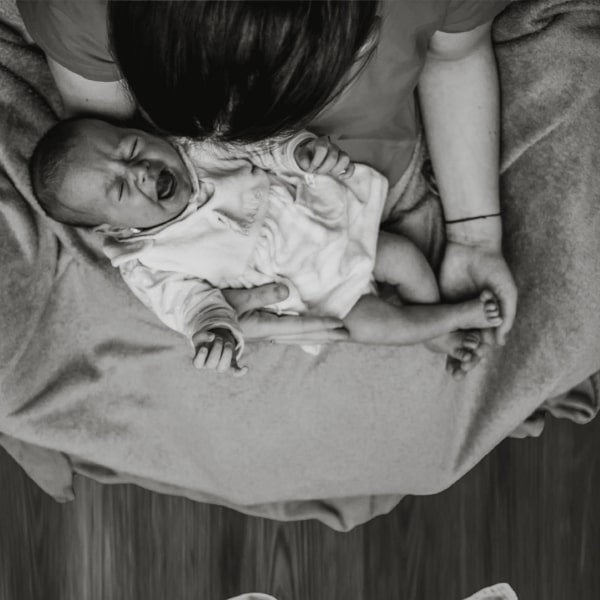


Every baby cries – some more, some less. Often enough, parents are at a loss and have no idea what is wrong with the child.
In the meantime, scientists have found out that there is more behind it when babies cry. In fact, the function of crying has been greatly underestimated until now. And although the crying is quite complex, it still seems to follow a certain pattern.

When babies cry: more than just screaming?
Today we know that crying essentially serves two functions. One is the obvious one: calling the parents when something is wrong. But the second function is also basically obvious: with its "communicative crying", the child gradually learns to babble and prattle. Crying is therefore actually a kind of preliminary stage to language acquisition.
Incidentally, it has been shown that boys cry slightly more on average than female infants. Researchers suspect hormonal causes behind this. But what the boys provide in quantity, the girls make up for in quality: their crying is somewhat more melodic at the age of two months and at around five months the girls are better at babbling.
Did you know? The crying of babies resembles the song of songbirds
Newly hatched birds learn their song in a very similar way to how human babies gradually recognize and learn language patterns. This realization came as a surprise, as a greater similarity to our closest relatives in the animal kingdom – the monkeys – had been suspected. But that was a mistake: monkey mothers communicate with their offspring hardly at all via sounds. For them, body language and gestures are the most important things. In humans, on the other hand, communication is based on the voice from a very early age: the baby cries, and the mother speaks to her child from the very beginning. As a result, the baby gradually learns the correct sounds from its parents and tries to imitate them. And it's basically the same with songbirds.
Baby crying: a relic from prehistoric times
Scientists have also traced how the crying of babies has changed over the years. What was the deal with crying among our ancestors? Back then, babies clung to their mothers' fur. If they were put down, they were defenseless against predators. So the baby cried to draw the mother's attention to its predicament. Over time, humans lost their fur, their gait became more upright and children were born earlier because the pelvis narrowed due to the upright gait. But baby crying has remained with us as an archaic heritage.
Different language, different crying
Another amazing finding was that, for example, French babies cry differently than German ones. In the last trimester of pregnancy, the baby perceives its mother's voice more consciously and imitates it after birth. The crying melody of a three-day-old French infant tends to rise, while that of a German baby tends to fall. Nevertheless, all babies, regardless of which country and regardless of which language culture, basically show four basic melodies that they all have in common.
Intuitive knowledge in communication between parents and baby
There is now a whole wealth of guidebooks that want to teach parents how to interpret their child's crying. Yet parents naturally possess the intuitive knowledge with which they do it exactly right in the vast majority of cases. Mothers and fathers, for example, automatically raise their voices when communicating with their baby. They also stretch the syllables. No one has taught them any of this before. Therefore, such guidebooks are actually more of a hindrance, as they separate us from our gut feeling.
Conclusion
There is more behind the crying of babies than meets the eye. While the assumption long prevailed that it was a pure alarm signal for expressing hunger or fear, we now know that it is a preliminary stage to speaking and that the first foundations for language acquisition are already laid in the womb. Although there are already differences in baby crying in different language areas, baby crying is based on a universal phonetic framework.
Talking a lot with the baby therefore creates optimal foundations for the child's later speech.
And giving them lots of closeness, love and security helps them to develop into a self-confident person capable of love.
The swing2sleep can also help here, which ensures a deep and restful sleep for the baby through the gentle up and down movement when bouncing, gives them security and safety through the narrow boundary and shielding from overstimulation, and additionally relieves the parents, who can also take a moment to breathe again thanks to the swing2sleep.