

A baby changes everyday life and brings quite a bit of action into the house. Your life is probably hardly comparable to the one you lived just a few months ago. Such a little person changes the entire daily routine and you have probably adapted your everyday life very much to the needs of your baby so far.
All the naps, constant breastfeeding or bottle-feeding and nightly waking phases had to be coordinated and, above all, managed – quite exhausting. But we can reassure you, it will get easier and over time there will be more and more space for mom's and dad's needs again.
With baby's 9th month, several developmental milestones occur, as the baby period is now in its final stages and your baby is becoming more and more of a toddler. Which developmental steps it goes through in this month and which changes are coming your way can be found in the following guide.

What's new in baby's 9th month
The world is a big adventure playground for your baby and wants to be discovered. In the ninth month, your baby's desire for discovery is awakened and the development of mobility is in the foreground. Perhaps you have already noticed since the eighth month that your child is now trying more and more to communicate and wants to have small conversations with you by speaking, bubbling and babbling.
Now you have to be very brave: Your baby is now slowly losing its baby fat and looking more and more like a toddler. But what progress can you expect from a baby in the 9th month? To give you a better overview, we have summarized the new month of life for you.
Sensory development – 9-month-old baby
A 9-month-old baby learns with all senses. While the senses of hearing and sight have already been trained in the previous months of life, the focus of most babies at nine months is on the senses called the body-related senses.
So if you notice your baby starting to pull themselves up on objects or wobbling back and forth while sitting, you might suspect a motor reason behind it, but in truth, your baby is currently training its sense of balance.
The sense of balance is one of the most important body-related senses, because without it, your baby will find it difficult to start scooting, crawling and later walking. Exploring toys with the mouth is a thing of the past. At 9 months, your baby explores objects with its hands and the sense of touch is getting better and better due to improved fine motor skills.
The motor development of babies at 9 months
This is where your little treasure collects milestones in the 9th month of life. Through the constant training of fine motor skills and the muscles of the fingers, your baby now no longer uses the whole hand when it wants to put something in its mouth, but the so-called scissor grasp.
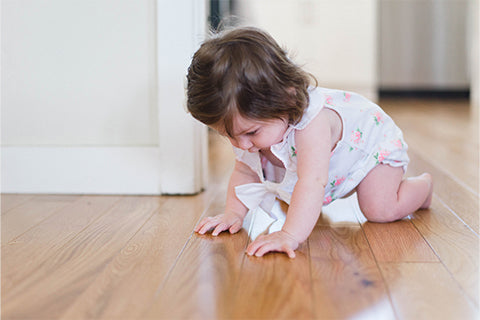
Now is a good time to introduce cutlery to your baby and offer them the chance to try eating with a spoon themselves. Most babies start scooting now. If your baby skips scooting, however, there is no reason to worry; children and their development are different and even if walking is the goal, the path is not the same for every child. Whether your baby is scooting, already crawling or perhaps rolling funnily through the apartment, one thing is certain: movement is coming into your everyday life. Your baby is perceiving its environment more and more and with increasing possibilities and new motor skills, independent excursions will no longer be a rarity.
The language development of a 9-month-old baby
Have you parents already noticed that your baby is actively trying to communicate with you? Not only is your baby now trying to speak and forming small strings of syllables, but it is also actively imitating your facial expressions. The babbling may still be incomprehensible, but your baby can now assign one or two words to an object or a person. Even if the individual syllables still sound disconnected, the words make sense to your baby. So it can certainly happen that frustration arises if you don't understand what it wants to tell you – that can be quite challenging. On the other hand, the joy is all the greater when it feels understood.
What a 9-month-old baby should be able to do:
Of course, you realize that your baby develops at their own pace and that this development cannot be compared with that of other children. Babies always develop exactly the skills that are useful to them at that moment, and this rarely happens according to the textbook. Do not stress yourself or especially your baby if they cannot do something yet; we are sure they have other qualities that are already more developed than in other children. Just like personality and character, the stage of development is different for every person, whether baby or adult. To give you an overview of what an average baby should be able to do in the 9th month, we have an overview for you here:
- The autonomy phase begins: Your baby wants to do everything alone and lets you know it. Your sweetheart's independence is now crystallizing, so the spoon might be snatched out of your hand, they might go on a diaper strike, or proudly hold the bottle themselves. Not always easy, we know, but staying persistent and letting them try pays off.
- When parents leave the room, they are no longer visible, but they are not gone. This new skill is not only a milestone for your baby but also gives you a whole new level of freedom. Where just a few weeks ago panic rose in your child when you were out of sight, an understanding of processes is now developing. In addition, in the 9th month, your baby can remember that a ball rolled under the cupboard, the pacifier is behind the couch, or that you have just left the room.
- Playing, including independent play, is now happening more and more. Your baby is now reaching an age where they want to play with and enjoy small balls, cars, or other moving objects, for example.
Baby in the 9th month: Sleep, nutrition, and encouragement
With every month of life, your baby is now taking big steps toward toddlerhood. You have probably already noticed that time seems to be racing and every month flies by. With increasing mobility, your baby's rhythm also changes, and your everyday life adapts anew. This is just as challenging for your baby as it is for you, and the transition can be a bit bumpy, but once the growth spurt is mastered, you can look back on it with pride. But how does sleep actually change at 9 months? What do teeth have to do with your baby's eating behavior, and what can you do to support your baby in their development? You can find out all that here.
Sleep in baby's 9th month
If your baby has needed several naps a day until now to process stimuli and impressions, this will slowly phase out. A 9-month-old baby wants to discover the world, and sleep is not on their priority list. Discovering new things, playing games, and practicing standing, sitting, and crawling certainly takes its toll, however, and so your baby's daytime naps shift to a midday nap, which will now probably last two to three hours. To make the transition from play to midday nap easier for your child, you are allowed to make it easy for yourself. A particularly popular aid is, for example, an Automatic baby hammock like the swing2sleep, which conveys a feeling of security with gentle up-and-down movements, just like in the womb. At night, your baby is now increasingly able to regulate themselves and find their way back to the land of dreams after a short waking phase.
Baby in the 9th month: What's on the menu
With the ninth month, not only do new teeth arrive that make it easier for your baby to eat finger food, but the pincer grasp is also getting better and better. This makes it easier for your sweetheart to pick up and try small bites with their hands and especially their fingers. In the process, the senses of touch and taste are also constantly improved. Does your baby turn their head away and refuse to open their mouth? This can be a sign that they are full, but it can also be their way of telling you that they don't like the taste.
Encouragement for 9-month-old babies
You certainly have age-appropriate toys for your baby to play with, but often it is also objects you know from your everyday life, such as empty bottles or old cardboard boxes, that magically attract your baby. All games involving motor skills will bring your baby joy; feel free to be creative and try new things. Expand your toy box with modified everyday objects; this strengthens your little one's sense of belonging.
The new month of life brings many new things, and you certainly couldn't be prouder of your little human. Remember to remove all possible hazards as your baby becomes more active and, above all, more mobile. A "yes-environment" can help you get through everyday life more relaxed. We hope we were able to give you a good overview of the changes in the 9th month with this article.