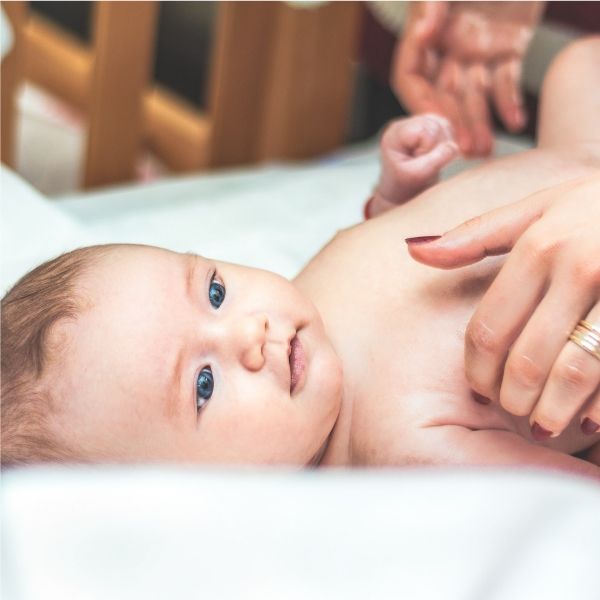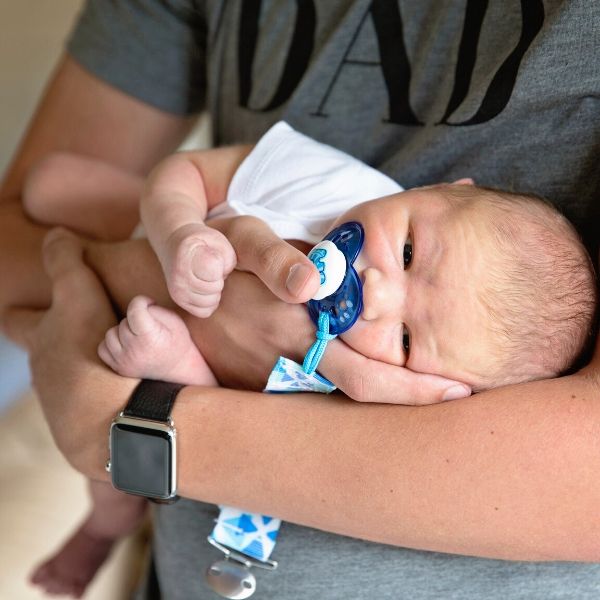



Just a blink of an eye and four months with your child have already passed – baby's 5th month begins. This period brings many milestones, as on one hand, your child will explore the world with open eyes, be increasingly active, and perhaps even roll onto their tummy. On the other hand, as parents, you can interact more and more with your baby; there will be laughing, gurgling, and playing. Perhaps your baby is already showing interest in solid foods and you have already looked into the signs of readiness for solids. To help you interpret the signs correctly, we have taken a closer look at the topic. But what about the general development of a five-month-old baby? What new skills are they learning and what does the daily routine look like? You can find out all this and much more in the following article.

Baby's 5th month: Development and milestones
The world is fascinating and a big adventure playground for your baby. For good reason, a five-month-old baby will now likely discover their environment with amazement and wide eyes. They babble and interact with you, discover objects and their own body – and they do so with all their senses. In the process, your baby is developing into an independent personality. You may have already noticed that your baby can tell you exactly what they want next and, even more precisely, what they don't want.
Your baby's development in the fifth month
A five-month-old baby is already quite advanced in terms of gross motor skills; they can probably already roll from their back onto their tummy. Some children even manage to get back from their tummy onto their back and move around in this, admittedly somewhat cumbersome, way. Even if it looks a bit uncomfortable, feel free to let your baby roll through the apartment. It is a precursor to crawling and a great way to explore the surroundings and channel pent-up energy. Neck stability is also increasing, and it is now no longer a problem to lift and hold the head while lying on the tummy. In addition, your baby is particularly flexible during this time, may make their first attempts at sitting, and often puts their toes in their mouth while lying on their back.
Improved hand-eye coordination in the fifth month
You may also notice that your baby's movements are becoming more coordinated and fluid. Hand-eye coordination improves noticeably, so that your child is able to reach for things purposefully and bring them to their mouth. Your baby can now already grasp a rattle with all fingers, which is also known as the palmar grasp. Once learned, your baby will probably be unstoppable and reach for everything that seems interesting – whether it's toys, objects on the changing table, long hair, or dangling earrings. Ouch! It is certainly advisable to take one or two safety precautions, avoid large jewelry, and tie your hair up while playing. You also probably can't put your baby down quite as easily now, because the new motor skills and rolling back and forth can quickly lead to accidents, for example, if they are on the changing table or on the bed. So, from now on, do not let your baby out of your sight.
See more, hear more, learn more
A baby in the fifth month begins to understand where sounds are coming from and subsequently turns their head in that direction. Vision is also growing, so your baby can perceive movements faster and follow them with their eyes. All of this is exciting, and it can now often happen that your baby is quickly distracted during eating and feeding by music, other family members, pets, or noises outside your four walls. It can help to withdraw a little and find a quiet spot in the apartment to give the bottle or breastfeed undisturbed and with full attention.
Baby's 5th month: The first teething
Some babies are real early starters in the 5th month of life, and so the first little teeth can start digging through the gums. The actual eruption of teeth usually occurs at the earliest in your child's 6th month, but some symptoms of teething may already be announcing themselves now. For example, your baby sleeps worse, is restless, asks for the breast or bottle more often, seeks more closeness to mom or dad, and has increased salivation. But don't worry, you can provide relief: we have compiled tips for soothing teething in detail and clearly in this article.
Emotional development in the fifth month
Your baby no longer recognizes you just by voice and scent, but also by face, and has built a secure and stable connection with you as parents. That's why they probably beam at you more and more often now when you speak to them from a distance – even without you coming into your child's field of vision. Conversely, it is quite possible that the first signs of separation anxiety may arise. Your baby might cry more often when they are not with you and you briefly leave the room, they may seek more attention, or sleep worse. This can be challenging, but it is a completely natural protective mechanism in the parent-child relationship to ensure the baby doesn't get lost – despite an increased urge to explore. Also, in your baby's 5th month of life, the first signs of stranger anxiety with other, less familiar people may occur. Outsiders are eyed skeptically, your baby clings more tightly to you, turns away, or starts to cry if they end up in the arms of an unknown person. This is also nothing to worry about and is solely related to the fact that your baby can now distinguish even better between other people and you as parents. Usually, early stranger anxiety in the 5th month passes quickly. The actual stranger anxiety phase in children, on the other hand, starts around the 8th month.
How to playfully encourage your 5-month-old baby
Your baby is now pushing themselves up on their arms more and more independently and trying to sit up from a lying position. You can gently support these first attempts at sitting, as this provides new perspectives and is a great experience for your little one. It is important that your baby sits leaning against you on your lap and only for a short moment. Do not sit your baby upright on their own too early if they haven't figured it out themselves yet, as the skeleton and muscles are not yet sufficiently developed.
Since grasping is becoming more targeted, your child is interested in everything they can get their hands on. You can offer them different toys but also everyday objects so they can explore various textures and surfaces, for example, wood, paper, leather, or plastic. Especially with paper rolls, you should always be present so that your child does not choke on small, soaked parts if they have put the paper roll in their mouth.
You can also entertain your baby with simple finger games, singing songs, or reciting short rhymes. However, always make sure to include enough breaks and rest periods in the daily routine. Around-the-clock entertainment is rather overwhelming at this age.
The feeding plan for your baby in the 5th month

Pre-milk or breast milk is still the main source of nutrition in your baby's fifth month of life. However, they may become increasingly interested in the solid food you are eating. It will happen more and more often that they closely follow what you bring to your mouth or even reach for it. According to the recommendations of the German specialist societies for baby food, you can start introducing complementary foods between the 5th and 7th month of life. Please speak with your pediatrician first and proceed gently with the introduction of complementary foods, and only once the signs of readiness for complementary foods are met.
Baby 5 months: Sleep
At five months of age, your baby has a daily sleep requirement of 14 to 16 hours per day. During this time, the day-night rhythm solidifies and the nightly sleep phases usually become longer. However, daytime naps are still important, and it is normal for your baby to take between two to four naps a day. You can slowly start to establish an evening bedtime ritual to help your baby fall asleep more easily. This can consist, for example, of a baby massage, changing diapers, and putting on pajamas, followed by carrying and singing or reading aloud. What your evening ritual looks like is entirely up to you. It is important that you always perform it in the same order. This gives your baby security on the one hand and also signals that it is now time to sleep. Furthermore, it enables your baby to find their way into the land of dreams more easily in the long run.
Shaping everyday life with your baby – and discovering the world
Perhaps you now feel more secure and confident in your role as parents after a few months together with your baby. Routines have solidified and you are approaching things more calmly. If you haven't already, now is a good time to participate more in everyday life again. Why not meet up with friends or go on your first major trip? So: shape your everyday life together with the child and discover the world together. Because this creates precious, unique moments. We hope we were able to give you a good overview of what it means to accompany your 5-month-old baby with this article.