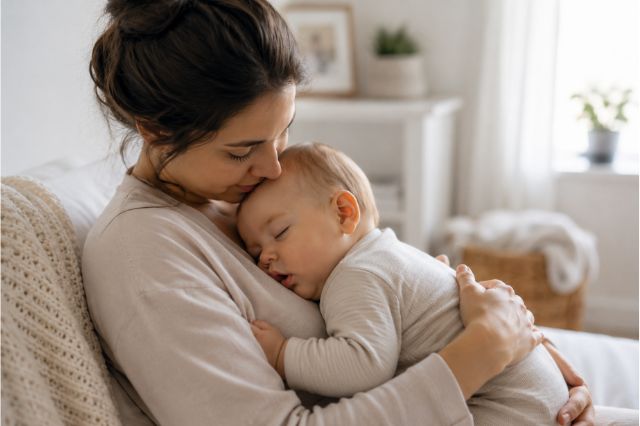
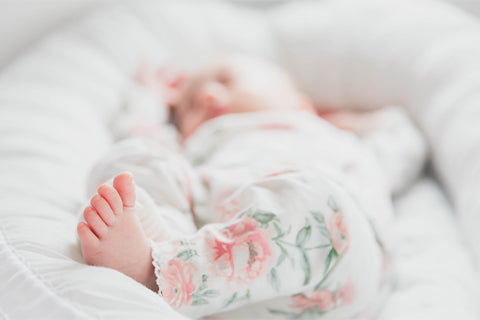


How time flies. You were just holding your newborn in your arms for the first time, and now your baby's 2nd month has already begun, and the little bundle has increasingly become a sturdy baby. They have shed their newborn status, and you are now observing exciting developmental steps in your child. Whether it's lifting their head slightly or that first smile – we have summarized the special milestones that await you in the second month of life, as well as the status of your baby's development, sleep, and nutrition in this article for you.
Your baby's development at 2 months
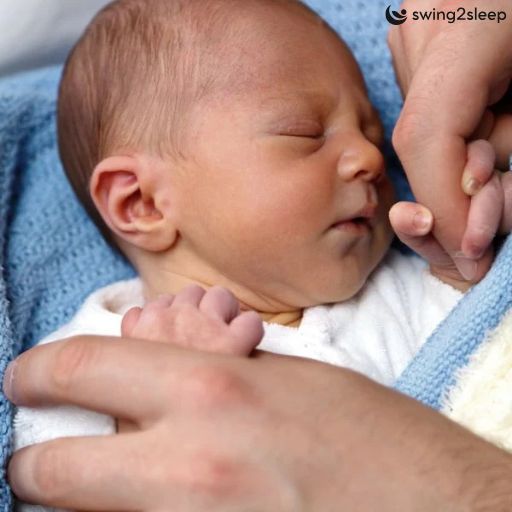
Your baby is growing and thriving in the second month of life and is now putting on significant size and weight. In terms of clothing size, your infant has probably reached size 56 to 62. By the end of the 2nd month, girls weigh just under 5 kilos on average, while boys have often already broken the 5-kilo mark. Of course, this always depends on your child's birth weight and how well breastfeeding or bottle-feeding is going. During this time, it is therefore primarily important that your baby gains weight steadily and moves within the growth curve. If you are unsure about this, you can always consult your pediatrician. But your midwife is also a good person to contact; she is responsible for weighing and measuring your infant during her home visits.
What your baby can already do in the second month – and how you can support them
But your infant is not only making great progress in terms of weight and size. Babies in their 2nd month also develop rapidly in terms of motor skills, emotions, and their senses.
Movements become smoother
Of course, your baby has not yet mastered targeted movement sequences this month. Instead, the first early childhood reflexes such as the Moro reflex decrease, and your baby now feels like moving. This manifests in arm rowing and leg kicking; some babies even push off so hard with their little legs that they push themselves backwards a bit, although this still happens in an uncoordinated way. Others contort their faces into funny expressions or rock back and forth on the changing table. All these movements are important for your child because they train their body, their coordination, and build muscle. You can support them by ensuring sufficient freedom of movement.
Lifting the head for the first time
Feel free to place your baby on their tummy regularly, as some can already lift their little head at least for a short moment during this time. This is a great experience for your infant because it not only strengthens their neck muscles during this exercise but also allows them to perceive their surroundings quite differently and much better than when lying on their back. It is important that you sit next to them at all times and can help your child if their head becomes too heavy again. Also, tummy time should only be practiced for a few minutes at the beginning to prevent frustration or overexertion. However, if your baby is absolutely unhappy in the prone position, you don't need to worry. Even without training, the little ones learn and develop normal muscles, entirely at their own pace.
Discovering their own little hands
In their second month of life, your baby will discover their own fingers and will likely be filled with wonder. Time and again, they will hold their hands in front of their little face, moving and observing them with fascination. During this time, your baby explores the world using their sense of touch and grasping reflex. You will notice how many of your baby's attempts to reach for something still miss the mark. So help them discover things: place toys with different textures and surfaces within easy reach, hand them over so they can reach for them, and motivate them with plenty of praise and encouragement. However, your baby does not yet understand that letting go is also part of grasping. The grasping reflex is still too pronounced.
The first social smile
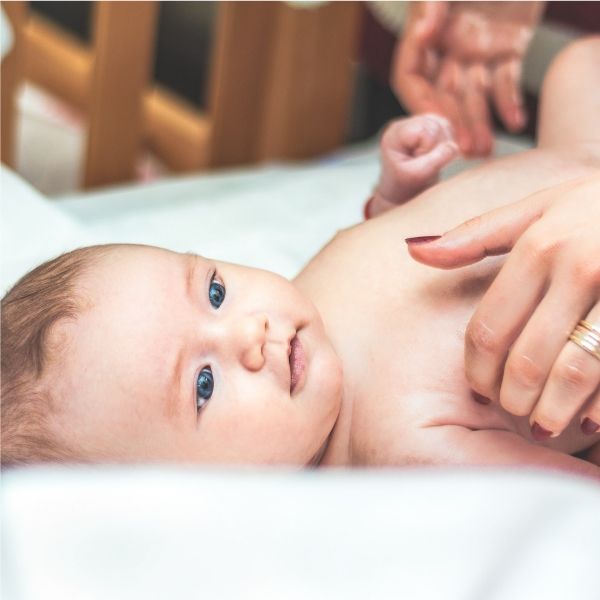
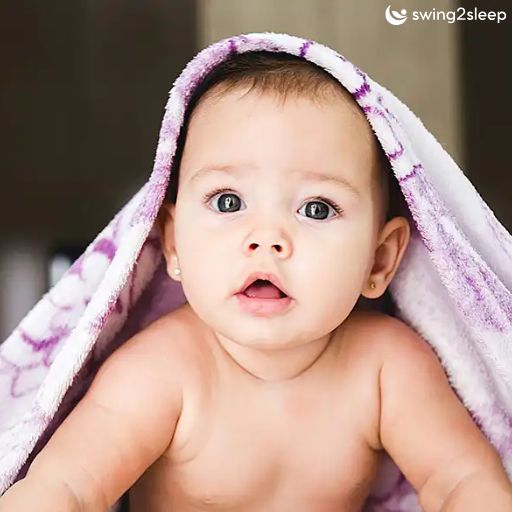
Just as your infant is now discovering their hands, they are also able to focus on faces, as their sense of sight develops particularly strongly during this time. They can also follow people or objects with their eyes, which you can also encourage through play. Your baby especially likes two-tone patterns right now, as they can recognize the differences between the colors. In addition, you will likely experience a special milestone in the life of your two-month-old baby: the first social smile. Unlike the "angel smile"—a reflexive muscle tension that usually occurs while the baby is sleeping—your child can now use their smile quite deliberately and warm your heart in this way.
Listening to their parents' voices
In the second month, your baby's reactions sharpen when they perceive a sound. An environment that is too loud is something your child still needs to get used to. It can certainly happen that your baby starts to cry or scream when noises are too loud to complain. On the other hand, if your baby hears your voices, they will look at you specifically or react with gurgles, squeaks, and babbles. These little conversations are incredibly fun, so it is always a good idea to talk to your child.

How much does your baby sleep in the second month?
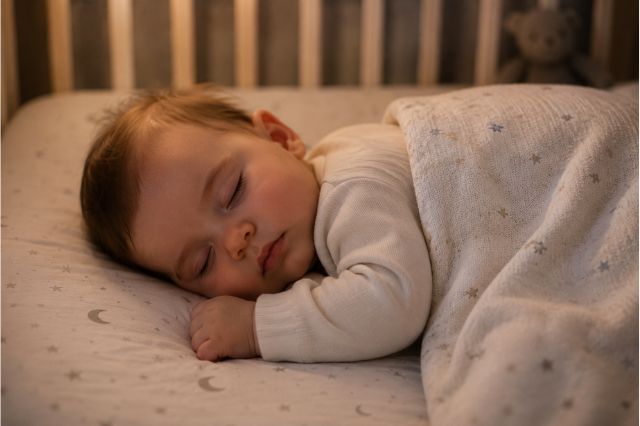
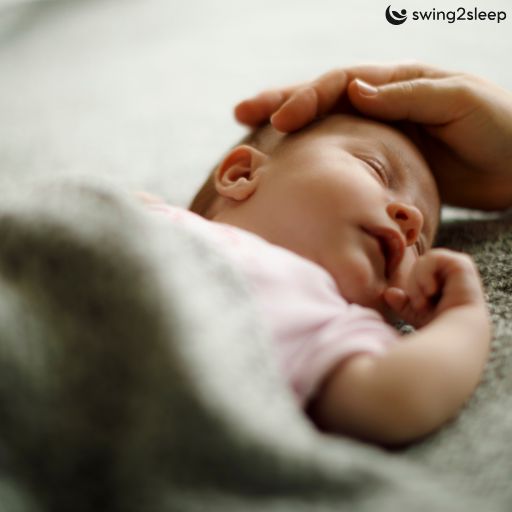
Slowly but steadily, your two-month-old baby is developing a day-night rhythm. Although your infant's sleep patterns are still far from those of their parents, the percentage of babies who sleep through the night at this age is very low. However, you don't need to worry that your baby isn't getting enough sleep, because it's not just nighttime sleep that's important, but the total duration of sleep spread throughout the day. This is around 14.5 to 16 hours per day, with only about 8-10 hours of that being nighttime sleep. Your baby will likely wake up about every 2-3 hours, including at night, and now has slightly longer waking phases during the day than in the first month of life. Only a few infants have longer sleep phases at night after the first growth spurt in the 5th week, but that is not the rule. So if your child wakes up more often, that is completely normal and not a sign of sleep deprivation. By the way: a two-month-old baby has a surprisingly late bedtime, usually between 8 p.m. and 10 p.m. It is only as they get older that it is advisable to put the baby to bed earlier.
Baby's 2nd month: How often should you breastfeed or bottle-feed?
Many parents are initially unsure whether their baby is drinking too much or often enough. There is no rule of thumb for how often an infant should be breastfed or given a bottle, as every baby is different and it depends on their individual appetite. However, you can remember that a healthy child in the first months of life may drink or be breastfed as often as they want. As long as the diapers are always wet and your infant continues to gain sufficient weight, you don't need to worry.
You can look out for these hunger signals:
- Your baby turns their head, opens their mouth repeatedly, and looks for the breast or bottle.
- Your baby licks their lips and sticks out their little tongue.
- They suck on their finger or fist and touch their mouth a lot.
- They are restless and fidgety.
You can recognize that your baby is full by these signs:
- The little body is relaxed, and the hands are no longer clenched into fists.
- Your baby makes satisfied smacking sounds.
- The breast or bottle is released.
- Your baby falls asleep.
The U3 check-up at the pediatrician and other health questions

In baby's 2nd month, the preventive check-up with your pediatrician is also due, the so-called U3. For many families, this is often the first examination carried out in the practice, as the two previous examinations usually take place in the clinic or birth center after delivery. Not only are reflexes and weight checked, but your baby also receives their first vaccination. The vaccination against rotavirus, a common pathogen of vomiting and diarrhea in infants, is an oral vaccine that should be administered after the end of the 6th week of life and before the 12th week of life.
Baby's 2nd month: Other important health questions
In addition to vaccination and weight gain, you may be concerned about other health topics in your baby's second month of life. We have summarized the most important points for you here at a glance.
Digestive problems and crying spells
Many babies at two months have digestive problems, abdominal pain, or three-month colic. These problems are often accompanied by prolonged crying spells, which can be exhausting and nerve-wracking for you and your child. We can reassure you that the long phases of uncontrollable crying usually have no serious medical cause. Furthermore, the crying phases generally decrease and disappear for most babies at the beginning of the 4th month of life. To calm your baby, there are various aids, such as carrying them a lot, structured daily routines, evening routines, but also the swing2sleep. The Automatic baby hammock uses gentle and even up-and-down movements to ensure that your child can calm down while lying snuggled up and safe in the hammock.
Diaper rash is nothing unusual::/H3
If your baby has a red, sore bottom or a reddish rash on the buttocks, then it is diaper rash, also known as diaper dermatitis. This is nothing unusual, but you can prevent the rash by changing the diaper regularly, especially after a bowel movement, and ensuring that the bottom is nice and dry after cleaning. A barrier cream with zinc is also helpful, but you should make sure to apply it only thinly. After bathing, you can let your child kick around without a diaper so that air can get to the skin. The room temperature should be adjusted accordingly so that your child does not get cold. If the rash does not go away on its own after a few days, a visit to your pediatrician is recommended to rule out a fungal infection.
What else is important for your baby in the second month
Bedtime ritual: Try to establish a bedtime ritual now in the second month of life to prevent sleep deficits. Watch for signs of tiredness such as rubbing eyes, uncoordinated movements, yawning, and light whimpering. If your baby is already crying, they are more than ready for a nap.
Correct lying position: Is your baby losing hair in the middle of the back of the head in the 2nd month? Don't worry. This happens because of lying on the back a lot, but it is harmless and, strictly speaking, a good sign. It shows that there is no head asymmetry. If, on the other hand, your infant has a favorite side and you notice one-sided hair loss, then encourage them to lie on the other side. For example, use colorful pictures and mobiles to make the other side of the sleeping area more exciting, and also change sides regularly when breastfeeding and bottle-feeding to prevent position-related asymmetry of the head.
You are becoming more confident – how wonderful!
Even if it sometimes feels like time is racing, always be aware that your baby has not even been in the world for two months. Many things may feel new and overwhelming to you as parents, and here and there you are not yet so practiced. That is totally okay. Always remember: your baby doesn't care about any of that. They need neither fancy rompers nor many toys. They need you, your attention, your closeness. As parents, you are enough for your baby, so try to enjoy this beautiful time and don't be afraid to ask for help if you feel overwhelmed. You wouldn't be the first parents to feel this way. We hope we were able to answer your questions about baby's 2nd month and that you feel strengthened in your role as parents by our article.